


An interview with Wonduk Seo, AI Researcher at Enhans
Enhans builds AgentOS around two areas: multi-agent systems and ontology. Both are central to the product, and both are open questions in current AI research. Over the past year, Wonduk Seo, an AI Researcher at Enhans, had three papers accepted at top international venues: ICML 2026, ACL 2026 Main, and ICPR 2026.
In this interview, Wonduk talks about what ties the three papers together and the colleagues at Enhans behind the work.
The Papers
• "SPIO: Ensemble and Selective Strategies via LLM-based Multi-Agent Planning in Automated Data Science", ACL 2026 Main
Wonduk Seo, Juhyeon Lee, Yanjun Shao, Qingshan Zhou, Seunghyun Lee, Yi Bu
About the paper: A multi-agent framework where LLMs go beyond simple code generation. They build memory over time and use it to put together full data science scenarios.
• "VisPath: Automated Visualization Code Synthesis via Multi-Path Reasoning and Feedback-Driven Optimization", ICPR 2026
Wonduk Seo, Daye Kang, Hyunjin An, Taehan Kim, Soohyuk Cho, Seungyong Lee, Minhyeong Yu, Jian Park, Yi Bu, Seunghyun Lee
About the paper: A framework that produces several visualization code candidates at once, runs them through a feedback loop, and lands on the strongest version.
• "OG-MAR: Ontology-Grounded Multi-Agent Reasoning", ICML 2026
Wonduk Seo, Wonseok Choi, Junseo Koh, Juhyeon Lee, Hyunjin An, Minhyeong Yu, Jian Park, Qingshan Zhou, Seunghyun Lee, Yi Bu
About the paper: A framework that uses ontology to surface the right personas and assemble them into a multi-agent system. The paper sits squarely on two of the things Enhans works on most: ontology and multi-agent systems.
Three Papers, One Question
Three top venues in one year. Do all three papers come from the same question? And how did you end up working with Yale, UC Berkeley, Princeton, and Peking University?
All three started from the same question. Can multi-agent systems do more than just talk to each other? Can they actually perform well in domain-specific areas like data science, visualization, and alignment? That question kept coming back to me through 2025, and the three papers are different angles on it.
The ACL paper is about LLMs going past simple code generation. They build up memory along the way and use it to put together the strongest scenario possible. The ICPR paper produces several visualization code candidates in parallel and uses a feedback loop to land on the strongest one. The ICML paper brings ontology and multi-agent systems together. These are the two areas Enhans is most invested in, so that one felt closest to the work I do every day.
On the collaboration side, Professor Yi Bu at Peking University was my advisor when I was a student. I still go to him when I run into something I can't crack. The other co-authors are people I've known for a long time, mostly from grad school and earlier collaborations. I'm usually the one who brings the proposal to them. We all want the same thing: a research community where people working on similar problems trade ideas and reviewer feedback. Working with people across institutions also gives me angles I'd never reach on my own.
Beyond the three accepted papers, I have around ten more in publication or under review since I joined Enhans. Writing things up is how I check whether our take on multi-agent systems and ontology actually holds up. It's also how we show that Enhans contributes to the field beyond what we ship in the product.
Practice and Research Are Not Separate Tracks
You worked on these papers alongside your day job. How did you split your time? And were there moments at work where you thought, 'this could be a paper'?
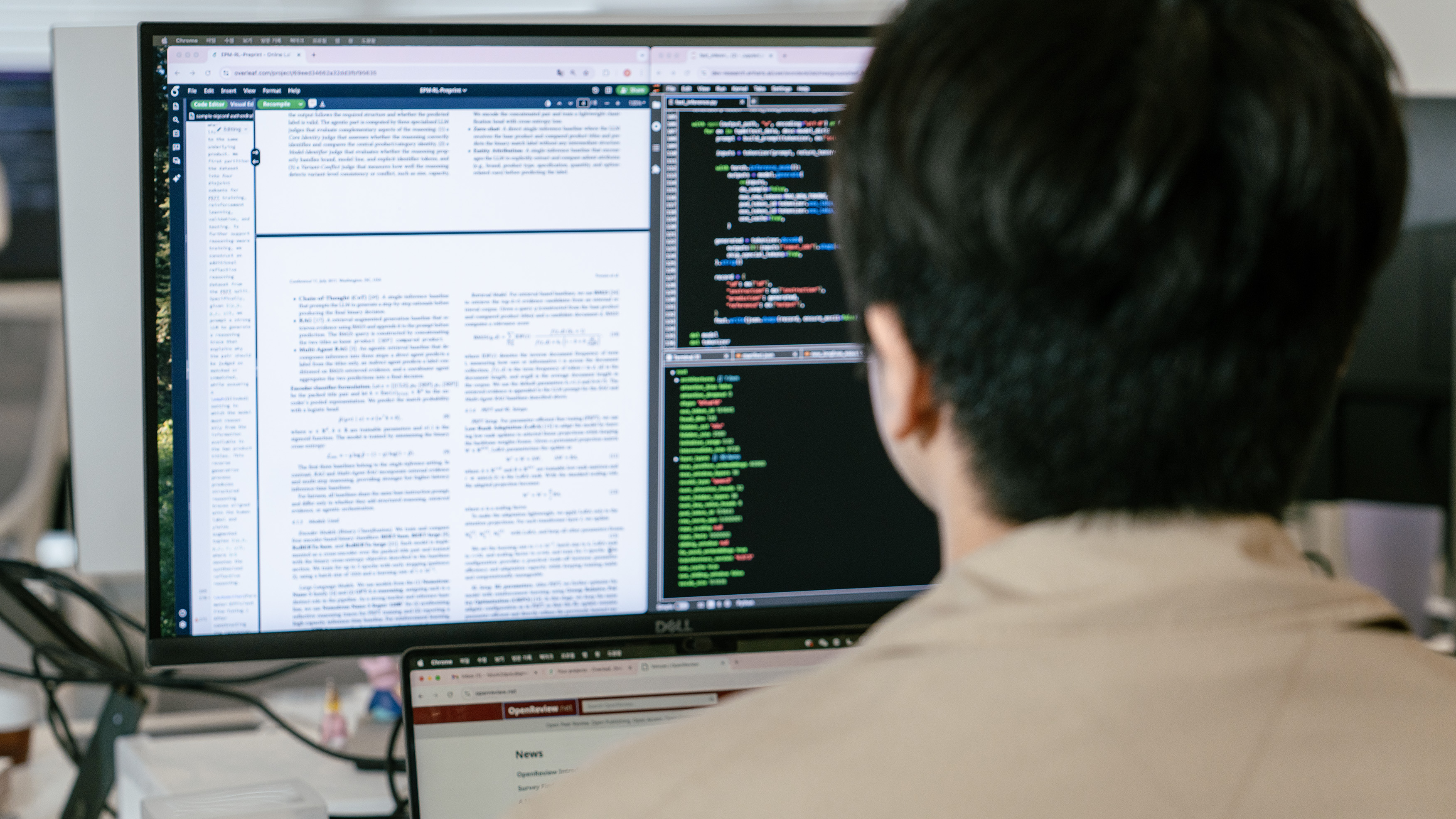
All the papers were done outside working hours. After work I'd head to a café near the office, grab a coffee, and run experiments and writing for a few hours before heading home. I don't really do time management. I just work on the research whenever I have time.
I keep looking for ways to improve the work right up to submission. So the days before a deadline go to checking which experiments are still missing and which parts of the writing need more work. I sort of enjoy the rush right before a deadline too. Some of the cleaner ideas in these papers came in that final 48-hour window.
The problems we work on at Enhans are the same problems academia is studying. So whenever a framework looks like it could perform well outside our internal product, I try to write it up. The clearest example is VisPath, which made it into ICPR 2026. In 2025 we were building a better LLM for visualization at Enhans, and that work produced a framework that explores multiple paths using a multi-agent setup and refines them through a feedback loop. That work became the paper directly.
It also goes the other way. Question to Knowledge, accepted at IEEE BigData 2025 last year, is a good example. We collect product data internally and feed it into our agentic system. In that process we kept hitting cases where two products had different names but were clearly the same item. The paper was written to solve that. The framework outperformed existing baselines, and we still use it inside the company.
OG-MAR at ICML follows a similar arc. I kept asking which kind of ontology system actually returns and connects information well, and along the way I found that the CQ-by-CQ method works for defining data relationships. We applied that to the paper framework, and we're also designing a custom ontology for AgentOS now.
Writing a paper goes beyond fixing one method and proving it. You find problems, fix them, and shape a complete framework by the end. Going through that loop again and again, you start to get a feel for whether a technique will work without having to run it. You also start to see several ways into the same problem.

No Paper Is Written Alone
VisPath has Daye Kang, Hyunjin An, and Minhyeong Yu as co-authors. The acknowledgments also mention Hochan Jeong and CEO Seunghyun Lee. How did each of them contribute?
If I'd written any of these alone, none of them would have come out the way they did. Daye Kang, a PM on the Agent Pipeline team, joined VisPath early on and worked on ideation and writing with me. She caught the gaps as we went and pushed the paper in better directions. Hyunjin An, a PO on the Agent Ground team, and Minhyeong Yu, an AI Researcher on the Agent Pipeline team, work with me across multiple papers beyond VisPath. Hyunjin designed the qualitative evaluation that tests how well the framework holds up with real users, and helped with the writing. Minhyeong looks at the algorithmic side and pushed the writing forward as well.
Hochan Jeong, a Marketing Manager on the Growth team, takes the papers I write and turns them into articles on the Enhans website. Whenever there's a result worth sharing, he works to get it out to the right audiences inside and outside the company. He makes sure the work doesn't end at the acceptance email. I'm grateful for that. Seunghyun Lee, CEO of Enhans, is the corresponding author. He weighs in on the direction of each paper and keeps me going through the harder stretches. The work is hard sometimes, and his support is a real reason I keep going.
Enhans has engineers, researchers, and domain experts under one roof. What does it look like to work across those backgrounds? And is there a forum for sharing research internally?
I used to mostly work with AI researchers and engineers, so there weren't many friction points. Working more closely with our backend engineers recently, though, there were moments where AI terminology didn't translate cleanly. Hybrid Retrieval was one of them. What was second nature to me was new to people from a different domain. I had a chance to walk through it end to end on a whiteboard, and there was a lot of back and forth in that conversation. We both came out understanding each other better. Our backend engineers now have all the basic AI concepts down.
For internal sharing, the usual flow is that when a paper gets accepted, I post the explanation and results in our Slack channel. If anyone has questions, I walk them through it one on one.

On to the Next Question
What are you working on next?
Right now I drive all the AI papers coming out of Enhans. I propose the topics, and they come from a mix of where the company is heading and what I'm personally drawn to. In 2025 I was working on multi-agent interaction. This year I've moved past communication itself and into how multi-agent systems can be shaped well for specific domains. The three papers this year went in order: visualization, then data science, then ontology.
What's next is still open. The two I keep coming back to are GEO, which the company is working on, and automatic knowledge graph construction, which I keep finding I need as I work through company problems. I want to design frameworks that work beyond single-use cases, write them up, and contribute to the field.
Right now I'm reading a lot on knowledge graph construction and talking to a few collaborators about where to take it. That’s where I’m headed next.
Read more about each of Wonduk's three papers on the Enhans blog.
• SPIO: A multi-agent framework for automated data science
• VisPath: Multi-path reasoning and feedback for visualization code synthesis
• OG-MAR: Ontology-grounded multi-agent reasoning

in solving your problems with Enhans!
We'll contact you shortly!