; Enhans :: AgentOS, The Operating System for AI Agents

The Operating System for AI Agents

AgentOS is the enterprise AI execution platform that connects data, meaning, agents, workflows, and action in one system.

From Data to Execution in One OS

AgentOS is not a catalog of pre-built agents. It is the platform where enterprises connect their data, define business meaning, build task-specific agents, orchestrate workflows, and carry results through to execution.
It is built to move AI from isolated experiments to structured, repeatable, and operationally useful execution across real business systems.

Connect enterprise data into a usable AI foundation

Translate business meaning into a form AI can understand

Build agents around real operational tasks

Orchestrate workflows across tools, logic, and conditions

Turn outputs into operational views and actions

How AgentOS Connects Data to Execution

AgentOS connects enterprise data, ontology, agents, workflows, views, and action in one execution architecture.

This structure builds on Enhans’s execution framework by making each layer explicit: from data connection and semantic structure to workflow control, operational views, and real action.

Pipeline Builder

Connect and prepare enterprise data.

Bring databases, APIs, and files into AgentOS so data is ready for AI execution.

Ontology Manager

Turn data into business meaning.

Define entities, relationships, rules, and terminology so AI can work with real enterprise context.

Agent Builder

Build task-specific agents on top of enterprise data and ontology, then connect them with tools, rules, and conditions to create workflows that can be applied in real operations.

App Builder

Turn outputs into usable views Deliver results through dashboards, generated views, and natural-language interfaces.

ACT-2

Execute actions in real environments.
Enable AI to observe, decide, and act across real systems and interfaces.

Add an AI execution layer on top of existing systems

Most AI tools stop at prompt experiments or analytical outputs. AgentOS is designed to build an ontology layer on top of the data and systems enterprises already use, then connect that layer to agents and execution flows that can be applied in real operations.
Differentiators
Add an AI operating system on top of existing systems
AgentOS uses the data and systems already running in the business, then adds a structure that AI can actually work with.
Translates data into a language AI can understand
It defines entities, relationships, rules, and terminology so AI can interpret enterprise context in a consistent way.
Enables multi-agent systems to operate according to enterprise logic
It allows enterprises to build and connect agents for specific business purposes so they can run within real workflows and operating logic.
Turns outputs into reusable operational assets
Dashboards and views are not one-time outputs. They can be edited, deployed, and reused over time.
Extends beyond insight into real action
Through its execution layer, AgentOS is designed to move beyond analysis and into action across real systems.
Learn how ontology supports enterprise grade execution

How AgentOS Works in Practice

AgentOS helps enterprises build AI systems for both external market environments and internal operational workflows. These are representative scenarios, not fixed product packages.
Use Case 01
Market Monitoring and Response
Learn more
Monitor market signals in real time and connect insights to operational response.
Built with:
Pipeline Builder, Ontology Management, monitoring agents, workflow logic, and dashboard views.
Example agents:
Price Agent, Social Media Agent, Brand Protection Agent
Use Case 02
Pricing and Promotion Operations
Learn more
Support pricing and campaign workflows with structured business context and execution logic.
Built with:
ontology-based business rules, task-specific agents, workflow orchestration, and result views.
Example agents:
Price Agent, Promotion Agent
Use Case 03
Quality and Workflow Automation
Learn more
Reduce repetitive work across QA processes and document-heavy operations.
Built with:
enterprise data inputs, ontology-driven task context, QA-focused agents, workflow design, and operational dashboards.
Example agents:
QA Agent
Use Case 04
Answer and Brand Environment Analysis
Learn more
Understand how products, brands, and claims appear across AI-generated answer environments.
Built with:
external signal collection, ontology-based analysis, review and monitoring agents, views, and reporting assets.
Example agents:
Review Agent, Brand Protection Agent

Built for Enterprise Deployment

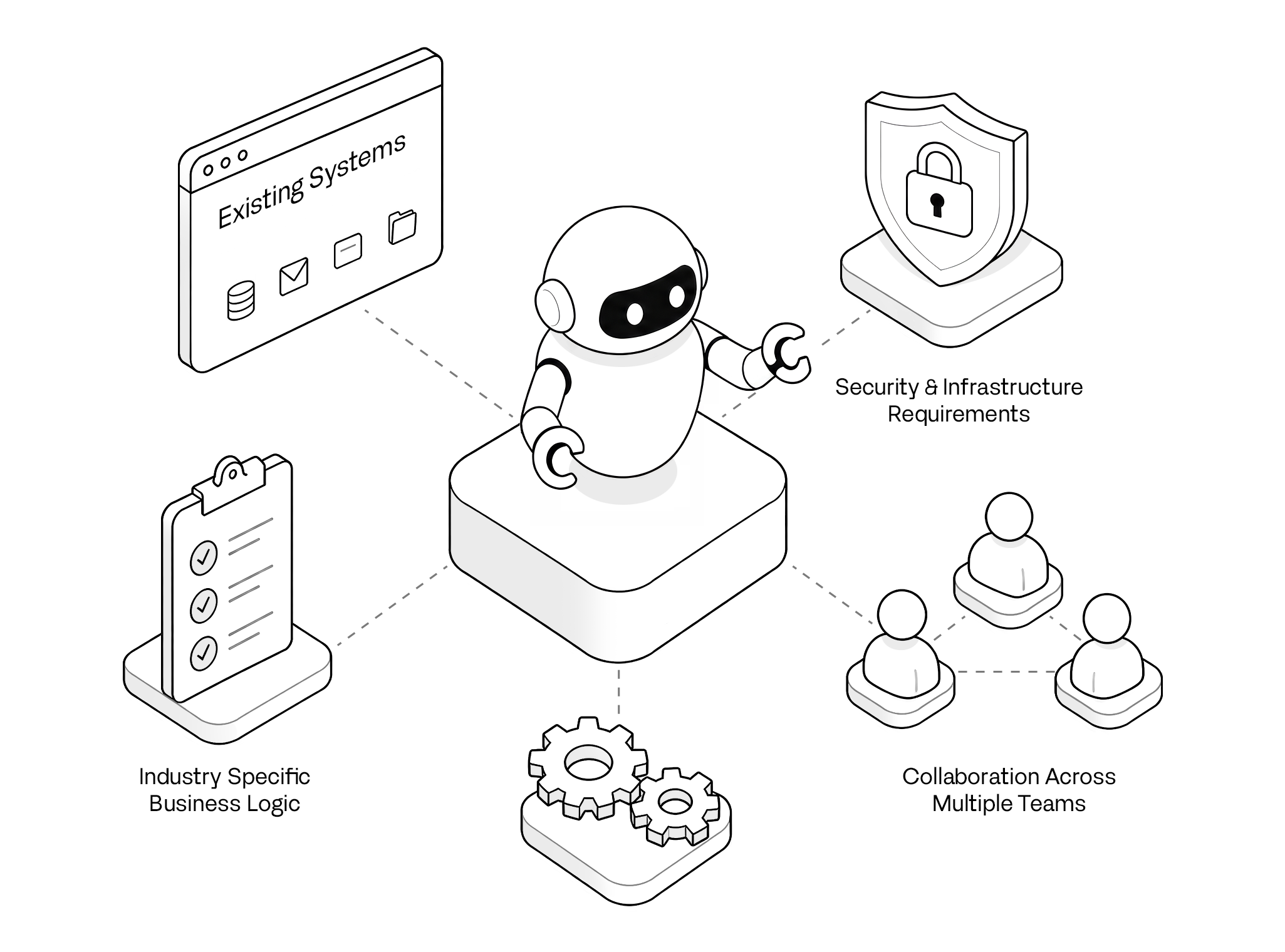
Enterprise AI must account for existing systems, security and infrastructure requirements, industry specific business logic, and collaboration across multiple teams. AgentOS is designed with those real deployment conditions in mind.

Builds a separate ontology lake while keeping existing systems in place

Instead of modifying enterprise databases directly, AgentOS uses Pipeline Builder to store the required data separately and organize it in a way AI can use.

Delivered flexibly across enterprise environments

It can be deployed to match customer infrastructure and security requirements, including on-premise and private cloud environments.

Supports complex business logic across industries

It is designed to support different operational structures across manufacturing, finance, commerce, healthcare, logistics, retail, telecom, energy, and more.

Built for collaboration across teams

AgentOS supports workflows that connect data, operations, planning, analysis, and execution across multiple functions.

Connects insight to execution

It goes beyond generating insights by linking workflows, views, and execution layers to real operational use.

Frequently Asked Questions

Q1. What is AgentOS?

AgentOS is Enhans’s enterprise AI execution platform. It helps companies connect their data, define business context through ontology, build task-specific agents, orchestrate workflows, and execute work across real systems. Rather than offering a fixed catalog of pre-built agents, AgentOS provides the architecture for enterprises to design and operate AI around their own business processes.

Q2. How is AgentOS different from pre-built AI agents?

Pre-built AI agents are usually designed for narrow, predefined tasks. AgentOS is different because it gives enterprises the tools to build, connect, and operate agents on top of their own data, rules, and workflows. This makes it possible to create AI systems that reflect real business context instead of relying on generic prompts or one-size-fits-all automation.

Q3. Why does ontology matter in AgentOS?

Ontology gives AI the structure it needs to work with enterprise context. It defines entities, relationships, rules, and terminology so agents can interpret information in a way that matches how the business actually operates. Without ontology, AI may generate plausible responses, but it is far harder to make those responses consistent, explainable, and operationally useful.

Q4. What kinds of agents can enterprises build with AgentOS?

Enterprises can build agents for a wide range of operational use cases, from market monitoring and pricing workflows to QA processes, document-heavy tasks, brand analysis, and response workflows. The key is that agents are built around the company’s own data, context, and goals, so they can be tailored to specific business tasks rather than limited to generic assistant behavior.

Q5. How does Agent Builder support safe execution?

Agent Builder connects agents, tools, rules, and conditions into controlled execution flows. This makes it possible to define how agents should operate, what information they can use, when actions should be triggered, and how exceptions should be handled. In practice, it helps enterprises move from isolated AI outputs to workflows that are more structured, reliable, and manageable in real operations.

Q6. How are outputs delivered to business teams?

Outputs can be delivered through dashboards, generated views, and natural-language interfaces. This allows teams to monitor workflows, explore results, ask questions, and use operational outputs in a format that fits their daily work. Instead of keeping AI results trapped in the backend, AgentOS turns them into usable views for decision-making and execution.

Q7. How does ACT-2 fit into AgentOS?

ACT-2 is the execution layer within the AgentOS architecture. While the other layers help connect data, define meaning, build agents, and orchestrate workflows, ACT-2 enables AI to observe interfaces, understand context, make decisions, and take action in real environments. It is what allows AgentOS to extend beyond analysis and into actual execution across business systems.

Interested in solving your
problems with Enhans?

  • 01.
    Tell us about yourself
  • 02.
    Which company or organization do you belong to?
  • 03.
    Which company or organization do you belong to?
Next
Next

Please see our Privacy Policy regarding how we will handle this information.

Thank you for your interest
in solving your problems with Enhans!
We'll contact you shortly!
Oops! Something went wrong while submitting the form.