


AI adoption is accelerating across private companies and public institutions. In the public sector, it began with chatbots that handle civil service inquiries and has since expanded to internal document retrieval, operational reporting, and support for day-to-day work.
As AI becomes part of more workflows, organizations must also manage the security risks surrounding these systems. A single prompt may contain information that is critical to an institution. Business documents often include vendor and executive names, national identification numbers, contract details, and facility information that must remain confidential. When employees use personal AI tools or external AI services for public-sector work, these materials may pass through unintended channels or become visible to unauthorized users.
In public-sector and defense environments, a data leak can affect critical operations, national security, and public safety.
Public agencies need an operating model that lets teams use AI while keeping control of their data. Broad restrictions often conflict with operational demand and efficiency goals. Sovereign AI offers a practical foundation for setting the necessary boundaries.
Data Sovereignty Belongs to the Organization Responsible for the Data
Companies should retain sovereignty over corporate data, while public institutions should retain sovereignty over institutional data.
Each institution needs direct control over where its data is stored, which AI models and systems can access it, and which workflows can use it. Its security policies and operating standards should cover the full data lifecycle, including input, retrieval, processing, execution records, retention, and deletion.
Data sovereignty also requires visibility into where information moves, how it is accessed, and how long it is retained. Without that visibility, an institution cannot reliably determine which information an AI system used to complete a task.
Enhans uses ontology to connect institutional documents, systems, operating guidelines, and processing histories within their business context. This allows AI to use the information it needs according to the institution’s data and operating standards.
Data Access Should Reflect Roles and Operational Responsibilities
Internal data should not be equally available to every employee or AI system.
Consider a public agency coordinating recovery after severe rainfall. The disaster response lead, facility manager, welfare officer, and external maintenance provider each have different responsibilities. Their access and execution permissions should reflect the work assigned to them.
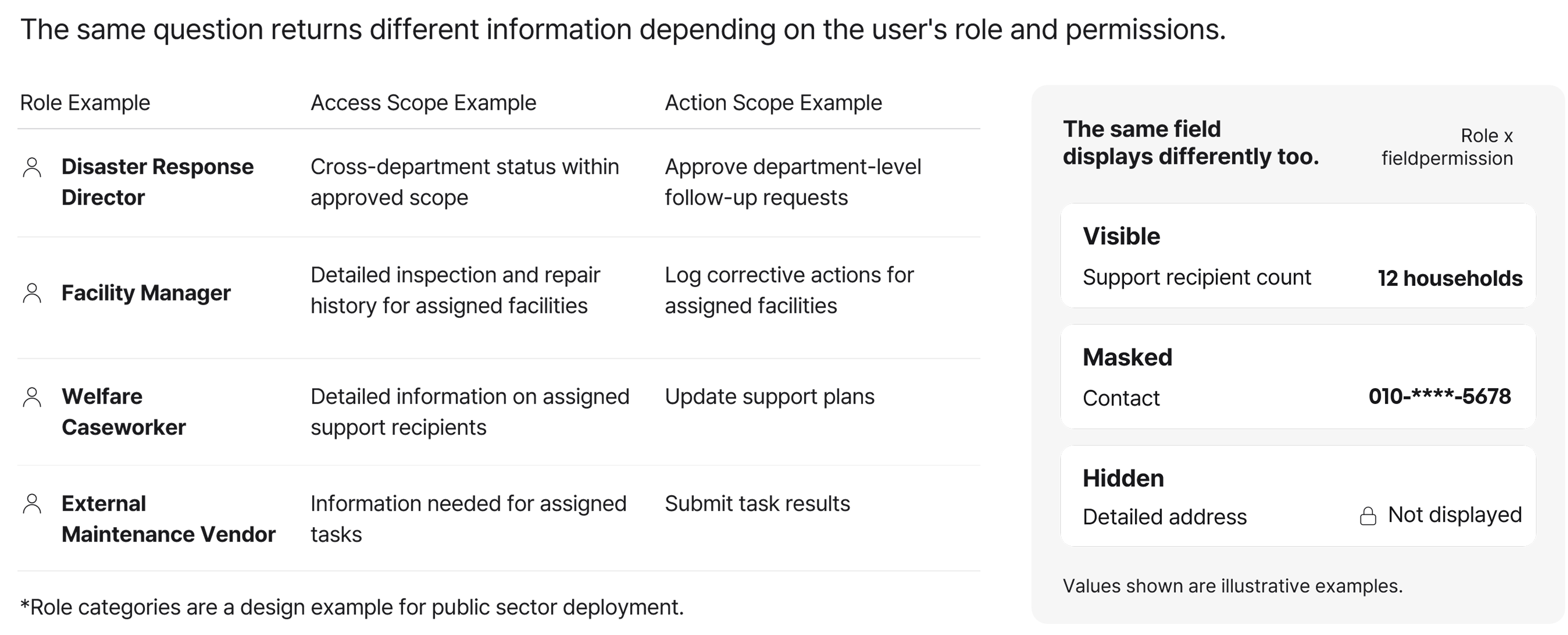
The disaster response lead may review cross-department status information within an approved scope and authorize remediation requests. A facility manager can review inspection and repair histories for assigned facilities and enter remediation details. A welfare officer may need access to the contact information, residential addresses, and support needs of assigned beneficiaries.
The same access permissions and data export policies that govern existing organizational systems should also apply to AI. The system should retrieve and answer questions using only information the user is authorized to see. Depending on the user’s role and business purpose, information may be displayed, masked, or hidden.
Access governance should prevent prompt bypass attempts from expanding retrieval scope or exposing confidential information in responses. Records of the sources used and results returned can support audits, operational reviews, and future updates to permission policies.
Responsible Staff Must Retain Authority Over High-Impact Decisions and Approvals
Under an institution’s operating standards, AI agents can find information, organize status updates, and prepare draft requests. Actions that carry institutional responsibility require review and approval from the responsible staff member. These include external communications, changes to benefit eligibility, security request submissions, and critical status updates.
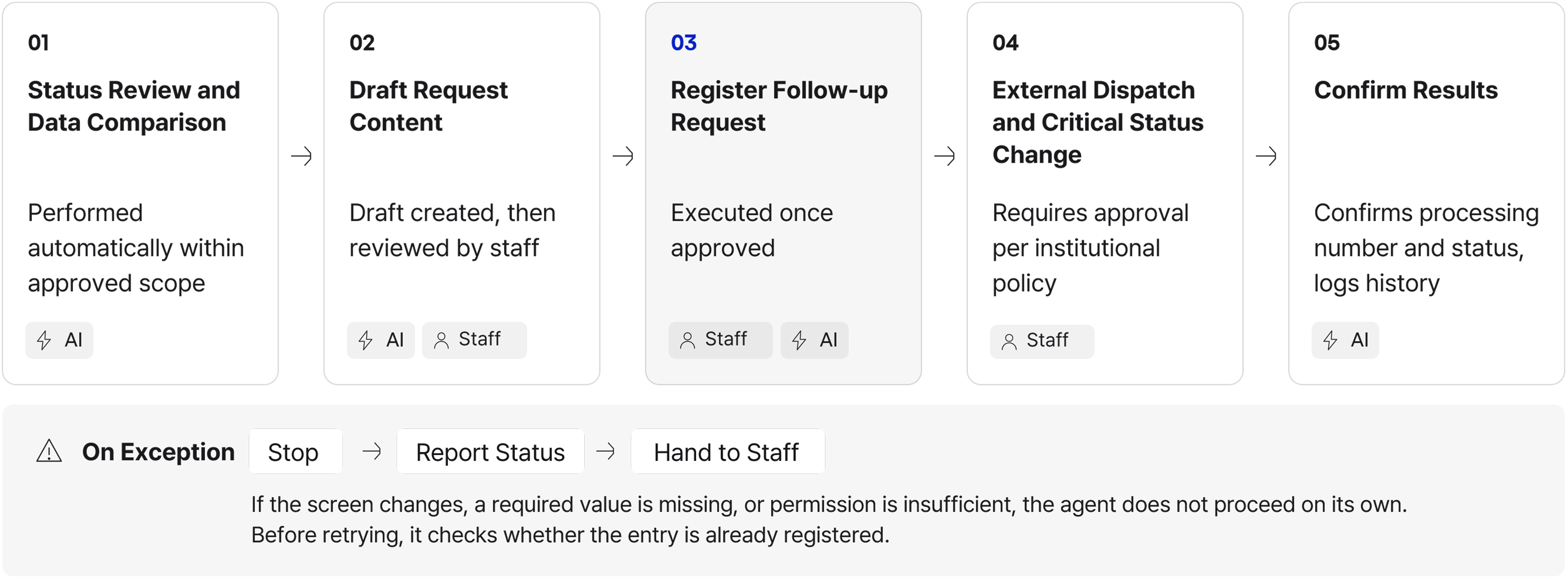
For example, an AI agent can use inspection records and repair histories to identify facilities with incomplete remediation and prepare a request. The responsible staff member reviews the facility, request details, assigned department, and deadline before approving it. The AI agent then registers the approved request in the business system, confirms the case number and resulting status change, and records the execution history.
If the interface has changed, required information is missing, or permissions are insufficient, the AI agent should stop. It should report the current state and reason for stopping, then ask the responsible staff member to decide how to proceed. Before retrying, the system should also check whether the request has already been registered to prevent duplicate execution.
Responsible staff retain authority over high-impact decisions and approvals. AI agents carry out approved tasks within defined standards and boundaries. This operating structure allows the institution to govern outcomes and maintain clear accountability.
Data Sovereignty Supports Operational AI in the Public Sector
Sovereign AI gives public institutions direct control over their data, operating standards, permissions, and execution procedures. The institution determines how data may be used, separates access by role, and retains authority over important decisions and approvals. Within those conditions, AI agents find information, prepare drafts, and execute approved work.
With these controls in place, public institutions can apply AI to real operations while protecting their data and decision authority. This is how sovereign AI preserves data sovereignty in the public sector.

in solving your problems with Enhans!
We'll contact you shortly!