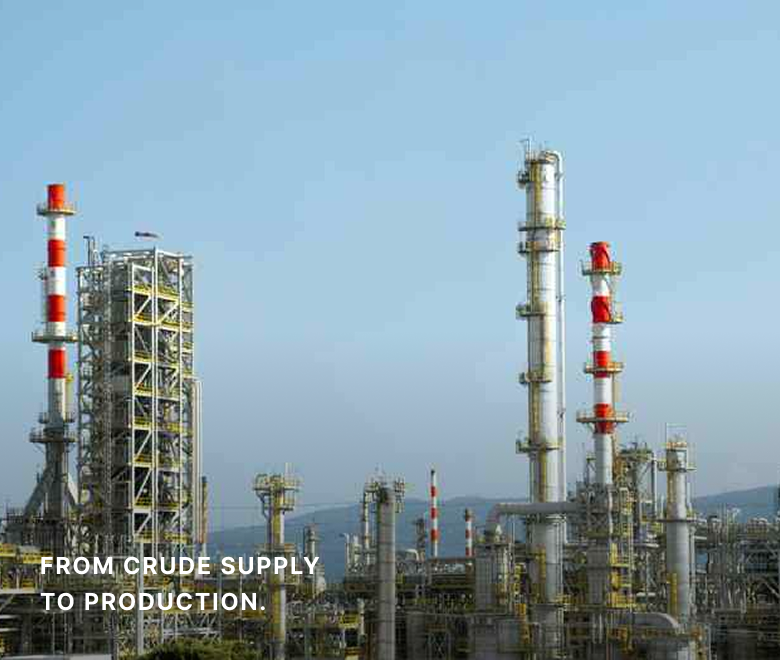
Changes in crude supply can impact the entire refinery production plan
Refinery production planning is connected across the full value chain, from crude supply and unloading to storage, blending, refining, and production. A change in crude properties or supply schedules can require coordinated adjustments across blending, equipment, process operations, and production planning.
Enhans connected refinery production planning data for a leading Korean energy enterprise through an AgentOS-based operating environment. Distributed operational data and decision criteria are structured through an ontology, enabling AI Agents to analyze dependencies and operating constraints, and present adjustment options with supporting rationale.
Crude oil supply
Supplier · Crude properties
Volume · Supply schedule
Arrival & unloading
Vessel schedule
Unloading schedule
Storage
Inventory · Tank capacity
Storage conditions
Crude blending
Crude properties · Blend ratios
Quality requirements
Refining process & equipment
Process conditions
Equipment status · Operating schedule
Production planning
Product mix
Production volume
Production schedule
A single change in operating conditions can cascade across blending, refining processes, and production planning.
Connect Data and Operational Relationships Across the Refinery Value Chain with Ontology
Enhans structures the relationships between crude oil, blending, process, equipment, and production planning data, together with the decision criteria used in refinery operations.
Within AgentOS, Pipeline, Ontology, AI Agent, Workflow, and Action work together to analyze operational dependencies and constraints within real-world workflows.
Pipeline Builder
Bring the data together

Ontology Manager
Give relationships meaning
Agent Builder
Evaluate the operational impact
App Builder
Make the next step clear
Crude supply
Storage
Equipment
Process
Connected operational data
One connected foundation
Connect and organize crude supply, unloading, storage, equipment, process, and scheduling data across existing enterprise systems.
From Operational Change to Impact Analysis and Adjustment Options
When crude supply or unloading schedules change,
AI Agents use the ontology to identify affected plans, evaluate operating constraints,
and surface actionable adjustment options.
Identify operational change
Crude supply · Unloading schedule · Equipment conditions
Analyze impact
Storage · Blending · Process · Production planning
Evaluate constraints
Crude properties · Inventory · Tanks · Equipment · Process · Schedule
Compare alternatives
Blending · Process · Operating plan adjustments
Action
Adjustment options · Impact scope · Decision rationale
EXAMPLE QUERY
“If an unloading schedule is delayed, which plans should we adjust first?”
The AI Agent identifies affected blending and process operating plans, then presents adjustment options and supporting rationale based on relevant operating constraints.
From Manual Plan Adjustment to Impact-Driven Operational Decision-Making
Instead of revising the entire plan whenever operating conditions change, teams can first identify what is affected and which plans can be adjusted.
Review systems and plans individually
Review connected data from crude supply through production
Trace operational impacts manually
Identify affected plans and their dependencies
Recheck constraints across individual plans
Evaluate relevant operating constraints together
Manually develop and compare adjustment scenarios
Surface actionable adjustment options
Rely heavily on individual operator experience
Make decisions based on operational relationships and constraints
MODELED IMPACT
40%
Less cross-team coordination effort
2.5×
Faster scenario evaluation
Representative modeled impact for production-scale deployment. Actual results may vary depending on the use case, data readiness, and operating environment.