



When enterprises first introduce AI agents into business workflows, attention usually goes to model performance. Teams compare which model is more accurate, which model can handle longer context, and which model performs better on complex reasoning.
Once AI moves into production, the question changes. Sending every request to the strongest model can feel convenient at first, but cost grows quickly as usage increases. Document classification, customer support, data cleanup, code execution, complex reasoning, and result verification all require different capabilities. When every task runs through the same model, the cost of execution can drift away from the value of the work.
Model routing can be one of the first levers for reducing AI operating cost. In enterprise environments, the larger question is how each task should be assigned, how the result should be verified, and where the operating standard should sit.
For AI to work inside real business operations, model selection, tool calls, retries, verification, approval, and usage logs need to be managed as one operating flow. Model routing is a way to control rising AI usage within cost, quality, security, and business performance standards.
The Best Model Depends on the Task
Model benchmarks are a useful starting point. Enterprise work, however, cannot be explained by a single benchmark score. Some requests need fast responses. Some require stable reasoning across long context. Some tasks depend on factual accuracy and traceable evidence. Others depend more on reliable tool execution or code generation.
For example, customer inquiry classification or document cleanup often has clear inputs and outputs. Using the most expensive frontier model for every one of these tasks can reduce cost efficiency. Contract interpretation or decisions that combine data from multiple systems may require stronger reasoning and more rigorous verification.
In enterprise AI operations, the best model for the job cannot be determined from a performance table alone. The work has to be defined first. What kind of request is coming in? What level of quality and speed does it require? What happens if the result is wrong? Model routing places the request into the right model and execution path based on those criteria.
Cost Changes When Quality Can Be Preserved
Cursor's public work on Cursor Router shows why model routing is closely tied to cost. Cursor described a router that does not fix all requests to one model. Instead, it selects a model based on query, context, task complexity, and domain. In early access customer examples, Cursor reported 30 to 50 percent cost savings compared with processing every request at Opus 4.8 API pricing.
Cursor's agent swarm experiment points in a similar direction. In complex tasks, a frontier model can plan the work while faster and lower cost models handle subtasks. This combination can preserve quality while changing the cost structure. When work is decomposed into smaller steps, not every step requires the same level of reasoning capability.
For enterprises, this distinction matters. As AI usage grows, cost is shaped by more than the price of the model. Cost also depends on which task goes to which model, where retries happen, how verification is handled, and how context is managed.
If the same level of output can be produced at lower cost, the operating structure should support that. Model routing is one way to design that structure.
Routing Criteria Differ by Enterprise
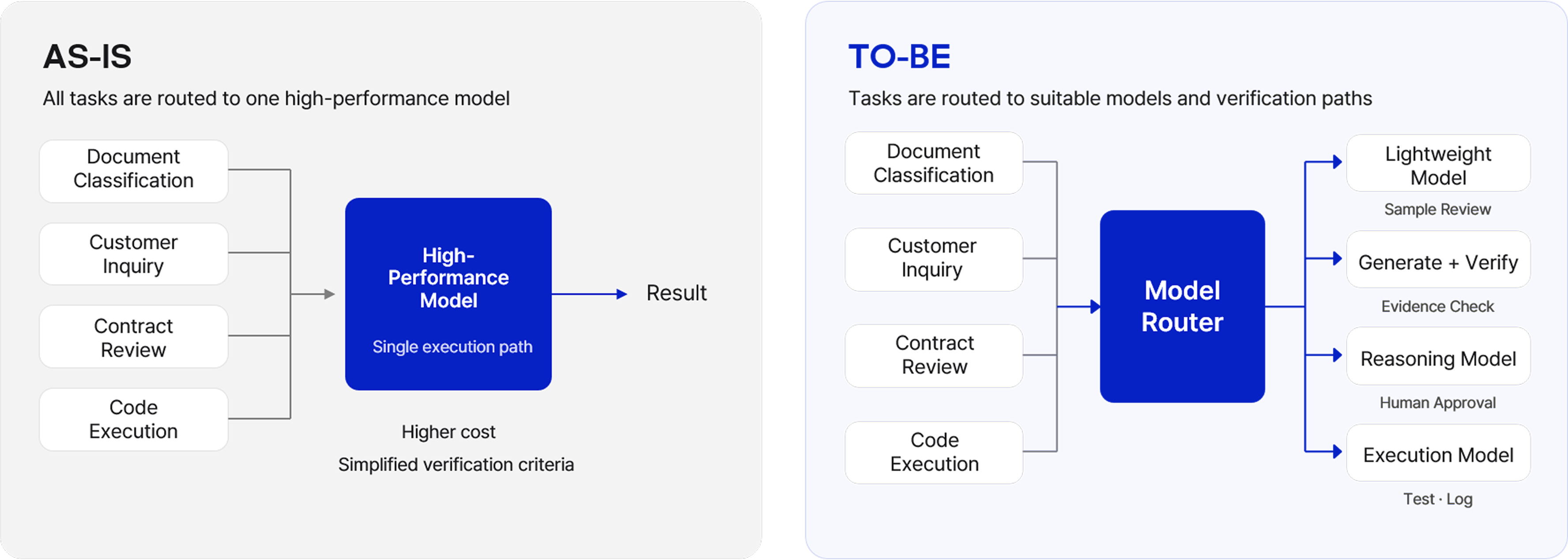
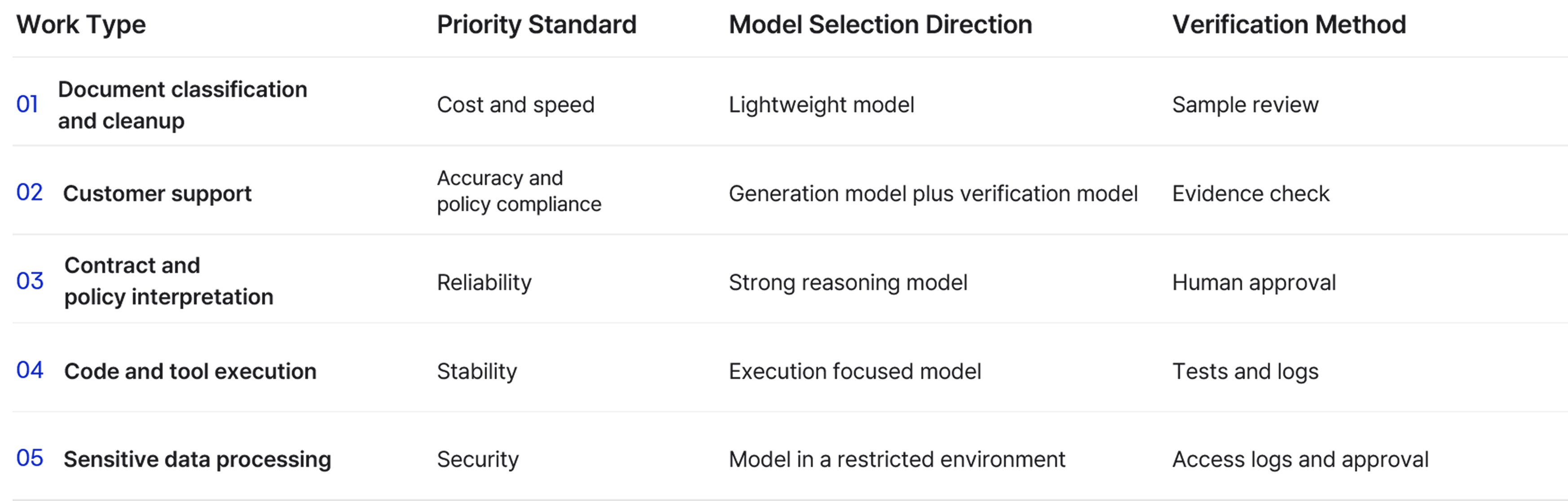
Every enterprise has different goals and operating constraints. Some organizations may prioritize cost reduction and speed. Others may prioritize the accuracy of customer facing answers. Companies that handle sensitive data may have restrictions on which models and environments can be used. Regulated industries may require human approval and execution records.
Even the same customer support workflow can be designed in different ways. One company may want most inquiries handled quickly and cost efficiently, with only exceptions escalated to a person. Another company may prefer to verify every answer with a separate model before it reaches the customer, even if that increases cost.
The same applies to software development work. A team focused on fast feature delivery may route more work toward speed. A team focused on stability and security may allocate stronger models and more review steps to requirement analysis, testing, and security checks.
This means enterprise model routing needs to reflect each organization's operating standards. Teams have to decide which work should be automated, where stronger models should be used, what data can be referenced, which tools can be called, and when verification or human approval is required.
Routing Has to Fit the Whole Operating Flow
In enterprise AI, the model is one part of the agent execution process. The right model and the acceptable cost depend on what the agent is doing, which data it can access, which tools it can call, and how much impact an error could have on the business.
Model routing should therefore be designed together with the nature of the work, data access scope, tool execution, verification method, and approval process.
This is also the direction Enhans takes with AgentOS. AgentOS is designed to help teams configure AI workflows around each customer's business context, record how agents execute tasks, and use those records to refine operating standards over time. When request type, data access, tool execution, verification, approval, and execution records are connected in one flow, routing standards can be designed around the actual business context.
If cost efficiency is the priority, routing can be designed to reduce unnecessary calls to high performance models. If quality and trust are the priority, multi model verification or human approval can be strengthened. If speed is critical, the execution path can be simplified. If security is critical, the movement of data and models can be more tightly controlled.
Routing Standards Improve as Usage Logs Accumulate
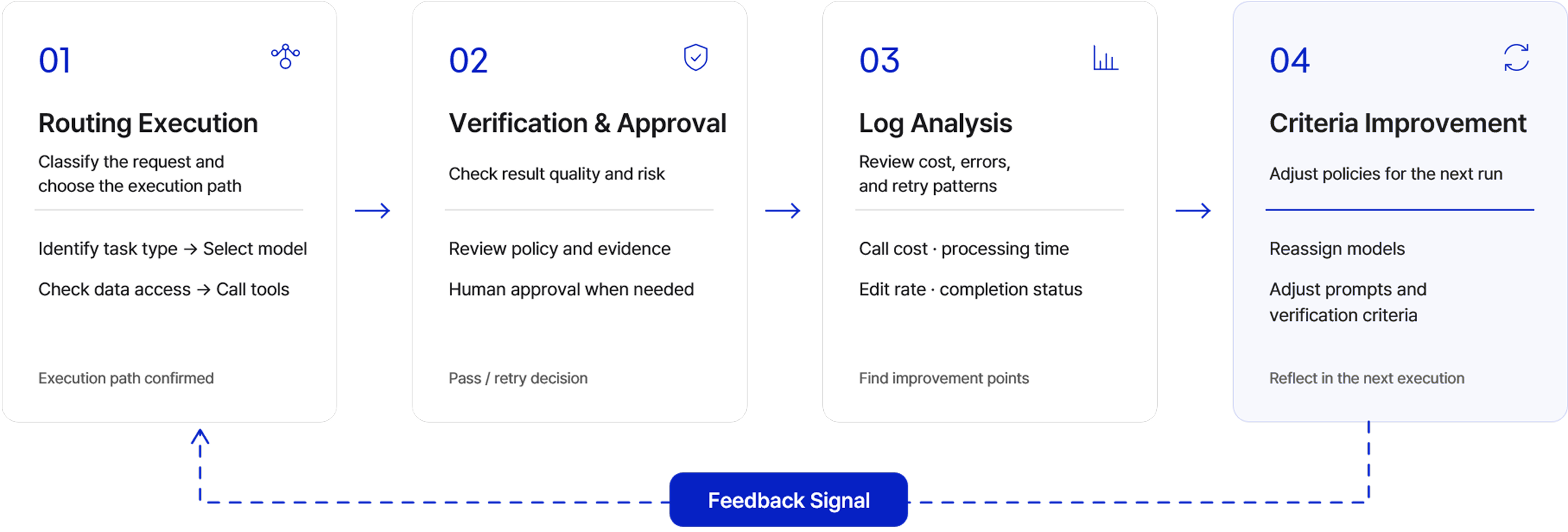
The first routing policy will rarely be the final one. Once AI enters production, patterns appear that are hard to predict in advance. A task that looked suitable for a cost efficient model may create repeated errors and retries. A task initially assigned to a high performance model may turn out to be stable enough for a lighter model. Requests in the same category can also vary widely in difficulty.
These differences become visible through usage logs. Teams need to see what type of request came in, why a route was selected, and which model and tools were used. Processing time and model cost are not enough. Retry count, verification result, human edits, approval status, and final task completion should also be recorded.
Consider an agent that answers customer inquiries. At the beginning, general inquiries may be routed to a cost efficient model, while requests that require policy judgment go to a stronger model. If logs show repeated retries or frequent human corrections for a specific inquiry type, that route should be adjusted.
In some cases, using a stronger model from the start can lower the total cost. In other cases, changing the model may matter less than providing better policy documents or more accurate customer context. If the cost of an error is high, a separate verification model or human approval step may be needed.
The standard for cost optimization is closer to the total cost of completing one business task at the required quality. This includes model usage, processing time, retries, verification, human review, human correction, and any downstream work caused by errors.
AI Usage Should Be Managed With Business Outcomes
Cost and quality alone do not fully explain the performance of enterprise AI. Teams also need to measure whether AI reduced customer inquiry handling time, reduced repetitive work for employees, lowered error or rejection rates, or allowed the same team to handle more customer requests.
What enterprises need to manage is how AI calls translate into business outcomes. If the same cost completes more work or reduces human intervention, routing efficiency has improved. If model usage increases but work time or error rates do not improve, that execution path needs to be reviewed.
Usage logs provide the evidence for this review. Request classification, model selection, data access, tool calls, verification, approval, and final execution should be recorded so teams can see which paths create performance for the cost. Stable workflows can move to more efficient models and simpler paths. Workflows with repeated errors and retries can receive stronger models or better context. Workflows tied to important decisions can receive stronger verification and approval steps.
Enterprise AI Scales Better When Business Standards Accumulate
Stronger models and lower cost models will continue to appear. Enterprises do not need to redesign their entire AI operating structure every time a new model is released. They need an operating structure for evaluating new models against existing business standards and moving them into more suitable positions quickly.
If cost, quality, success rate, retry count, human intervention, and business outcomes are accumulated by workflow, new models can be compared within the same operating criteria. Some tasks may achieve sufficient quality with a cheaper model. Other tasks may require a stronger model because it reduces total retries and review cost.
Model routing is an operating structure for continuously finding the best fit for each business task. When models are assigned by task type, standards are adjusted with operating data, and new models can be repositioned when they appear, enterprise AI can scale while managing cost, quality, security, and business performance together.
This is also aligned with the direction of AgentOS. When AI workflows can be configured around different business conditions, execution processes and outcomes can be recorded, and those records can be reflected back into operating standards, AI operations become more precise over time. Model routing can be handled within this broader operating flow because teams can use operating data to decide which task should go to which model, which results need verification, and where a new model should be placed.

in solving your problems with Enhans!
We'll contact you shortly!