



Many enterprises deploy AI and still find that it does not translate cleanly into day-to-day work. When an agent executes a task, teams may not be able to see the process, verify the result, or roll back cleanly when something goes wrong. These are the conditions that prevent AI from taking hold in enterprise operations.
The engineering frameworks designed to address this have continued to evolve. Harness Engineering described how multi-agent systems can be made reliable in practice. Loop Engineering extends that conversation to repeated execution: how work starts, how it is checked, how it is recorded, and how each run feeds the next.
Boris Cherny, who led the development of Anthropic's Claude Code, has described modern AI engineering as moving closer to building loops than writing prompts.
For individual work, an AI agent that drafts content or edits code quickly can be useful on its own. Enterprise conditions are more complex. When an agent begins accessing internal data, operational systems, business rules, and organizational knowledge, both the outputs and the execution process need to be managed.
Loop Engineering is the practice of designing execution structures in which AI agents attempt tasks, verify results, make corrections, and repeat, moving toward a defined goal. In enterprise environments that span multiple data systems and operational tools, the execution process, the verification criteria, and the change history matter more than any single answer. Enhans defines Loop Engineering as a way to structure repeatable execution and verification, so that people can focus their time on interpreting context and making the decisions that require human judgment.
Execution Conditions: When Does a Loop Start and When Does It Stop?
Designing a loop starts with a clear start condition. The loop might begin when a person initiates it, at a scheduled time each morning, or based on a specific trigger such as a new pull request, a failed test, or incoming customer feedback. When the start condition is vague, the loop depends on human memory to kick off, and that dependency removes the core advantage of repeatable execution.
A loop also needs a goal and a termination condition. "Handle this problem" is not a suitable instruction for a loop. "Find and fix the cause until the tests pass." "Organize incoming feedback according to the existing classification framework." Success needs to be checkable. Because a loop keeps moving, the condition for stopping matters as much as the condition for starting.
Safety Design Is as Important as Execution Conditions
Verification is a core component of loop design. An agent producing an output does not mean a task is complete. Coding work needs signals such as test results, type checks, builds, and lint. Research work needs source dates, original links, and alignment between claims and evidence. Weak verification means a loop can generate outputs quickly while stacking up unsupported assumptions.
Workspace isolation is equally important. Applying unverified changes directly to a production environment creates real risk. A recoverable space, such as a git worktree, a separate branch, or a sandbox, needs to be part of the design. More iterations strengthen a loop, but they also increase the probability of something going wrong.
Loops also need memory. Relying solely on a model's conversation context means that what was done yesterday, and which approaches already failed, can easily disappear. External memory in the form of state files, task logs, and documented decisions allows a loop to read the record of previous executions and continue from there, rather than starting from scratch each time.
How Loops Scale
LangChain describes Loop Engineering as a stack of agent loops, verification loops, event-driven loops, and hill-climbing loops. The operational structure of Loop Engineering consists of multiple connected layers. Inside, agents use tools to perform work. Around it, result verification, business event triggers, and improvements based on execution records follow in sequence.
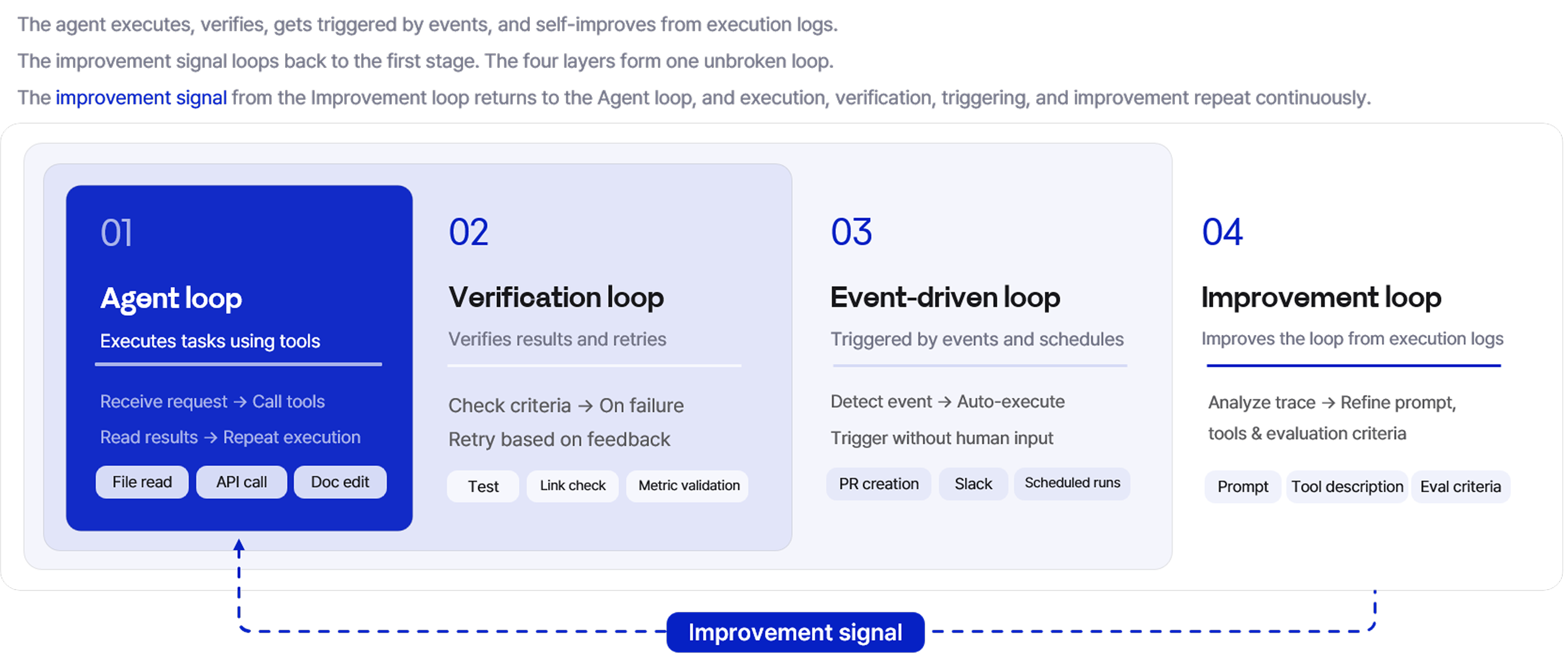
The foundation is the agent loop. A request comes in. The model reads the current context, decides the next action, and calls the necessary tool. It reads the result, decides the next action, and repeats. This continues until the model determines the task is complete. At this layer, AI operates inside an execution flow: reading files, calling APIs, querying data, and updating documents.
The next layer is the verification loop. Once the agent produces a result, the loop checks whether it meets the defined criteria. Did the tests pass? Do the links resolve? Does the analysis match the defined metrics? Does the document satisfy the specified standard? When the check fails, the loop retries based on the feedback. The verification loop assumes that AI errors can happen and builds a structure for catching and correcting them.
The third layer is the event-driven loop. Rather than a person pressing a button each time, events within the business system start the loop. A scheduled time arrives. A webhook fires. A request appears in a Slack channel. A PR is created. New customer feedback comes in. The agent begins. At this layer, the agent starts to function as a component inside the organization's workflow.
The fourth layer is the improvement loop. Each agent execution leaves a trace. The trace records what the model decided, which tools it called, and what feedback the verification step produced. Analyzing these records reveals where prompts, tool descriptions, permission boundaries, evaluation criteria, and data descriptions can be improved.
The behavior of any given loop will vary by task. Some loops advance one turn at a time with human guidance. Others receive a goal and termination condition and run until completion. Some fire from a schedule or an event. Some detect recurring inputs and proactively generate proposals or drafts.
When these four layers connect, repeatable execution becomes an operational structure. A loop becomes valuable when each run leaves behind something the next run can use: the execution result, the verification outcome, the record of what changed, and a signal for improvement. When execution, verification, logging, and improvement are connected, a loop becomes a reliable operational structure for the enterprise.
How Loops Are Used in Ontology Building
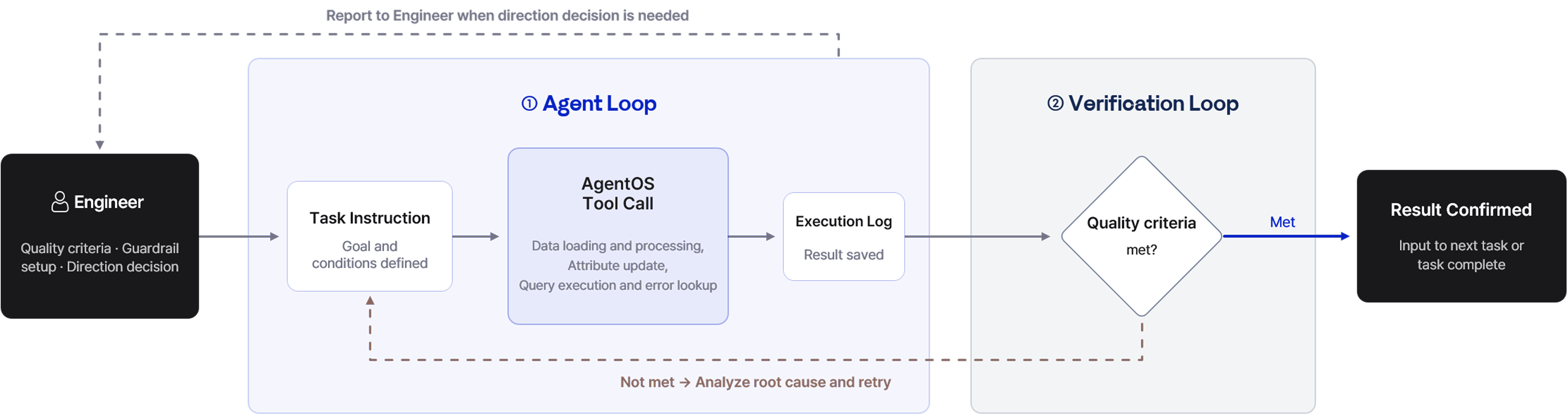
Enhans turns the repetitive verification work that arises during AI deployment projects into loops, so that FDEs (Forward Deployed Engineers) can spend more time examining client business context and problem structure.
Ontology building is a clear example. An ontology defines what a client's data means, how different data connects, and how it should be interpreted according to specific business terms and criteria. It determines what "revenue by region" means when a user asks that question, which data to reference, and by which standard to answer.
Before loops were applied, the repetitive verification work in ontology building had to be performed manually. Every time similar tasks came up, such as checking data sources, adjusting data descriptions, running queries, verifying answers, and tracing errors, a person had to intervene directly. When people handle this cycle manually each time, a significant portion of the workday goes to execution tracking and record-keeping.
Loop Engineering turns this repetitive process into an observable, verifiable structure. While agents handle execution and verification cycles, people can focus on interpreting business context and determining direction. This is where loops become an operational approach that raises the overall quality of an AI deployment project.
Agents Repeat. People Refine.
The loop begins by analyzing client data and requirements. It identifies data structure, business terminology, and the purpose of the analysis, then maps these into data descriptions and relationship definitions that AI can use. It then runs queries representative of what real users would ask and checks whether accurate answers come back. Each response reveals which data was referenced, how the query was constructed, and what errors occurred.
That execution record becomes the input for the next iteration. If answer quality needs improvement, the data descriptions are made more precise. If execution performance needs improvement, the generated queries and logs are examined to determine whether pre-aggregated data is needed. When a change is complete, the same queries run again, and the results are compared to the previous run.
Human judgment continues throughout. The engineer interprets the client's requirements, determines what to verify, and selects which correction approach fits the business objective. The agent handles execution log collection, query execution, error tracing, and re-verification. Where human judgment is required, the loop pauses. When direction is set, that decision becomes the input for the next execution.
Where to Start: AI Operational Loops for Verifiable Tasks
A consistent pattern appears across enterprise environments.
Loops work well for tasks that occur frequently, have clear success criteria, and can be rolled back when they fail. Coding tasks are the clearest example because verification signals such as tests, builds, type checks, and reviews are relatively well-defined. For the same reason, loops are a natural fit for recurring report updates, document reviews, email and notification triage, customer feedback organization, and research document maintenance.
Tasks that are vague in their goals, subjective in their evaluation, costly when they fail, or weak in verification require more caution. Product strategy, legal judgment, security-sensitive operational changes, and decisions involving payment or contracts are areas where an agent can help with preparation but should not carry the final execution independently.
When introducing Loop Engineering in an organizational setting, there is no need to build a large automation system from the start. A good entry point is a small task that people are already repeating. Daily failure log reviews, recurring meeting note summaries, frequent PR checks, periodic research document updates. Tasks that are time-consuming to do manually but have relatively clear output standards are good candidates.
Before writing instructions, define the termination condition. What state signals completion? What evidence indicates success? Under what circumstances should the loop hand off to a person? Loop quality is determined by termination conditions and verification methods, not by a well-worded prompt.
Starting with read-only loops is the safer approach. Let the loop gather information, classify content, generate proposals, and produce reports. When results are stable, the next step is assigning write tasks that are easy to reverse: updating a document draft, modifying code on a separate branch, posting a comment on an issue.
What to Manage When Running Loops
In practice, even a well-designed loop often cannot sustain itself in an organizational environment without proper permission design and a logging system.
Cost, speed, permissions, and understanding debt all need to be managed together. Because loops execute repeatedly and continuously call external tools, even a small loop can become expensive when it runs frequently. Time limits, iteration caps, and automatic stop conditions are necessary. A loop that moves fast without verification can accumulate incorrect results just as quickly, so evidence such as tests, logs, source citations, and reviews is needed to confirm what was produced.
Permission design matters as well. When an agent accesses databases or deployment systems, it can affect live operations. Starting with read-only access, expanding write permissions gradually, and requiring approval before irreversible actions are sound defaults. Human oversight needs to be built into the loop itself. Clear approval steps before sensitive tool calls, review before results are published, and sign-off before harness configuration changes all make agent loops safer to run in production.
The records a loop leaves behind also need attention. These records should capture what was done, why that judgment was made, what was used to verify it, and what remains uncertain. They allow the next execution to avoid repeating the same mistakes and give people the confidence to extend the next set of permissions. When reasoning, evidence, and verification history accompany results, a loop becomes an operational practice that can sustain itself over time.
Closing
Applying AI agents to real work requires designing both what gets automated and where human judgment must remain. When repeatable execution and verification run inside a loop, people can focus on interpreting results and deciding what comes next based on actual business context.
Enhans performs this design work alongside clients in AI deployment projects. We develop an understanding of each client's data structure and business criteria, define verifiable execution units, and build the operational framework for agents to take on repeatable verification.

in solving your problems with Enhans!
We'll contact you shortly!