



As enterprise AI adoption grows, companies face a practical question: which parts of a workflow should AI handle, and how much authority should it have? The answer starts with a closer look at how the work actually gets done.
Much of that work begins with classification. Take a customer service request. The team first identifies whether the issue involves a shipping delay, a product defect, a refund, an exchange, or a payment error. It may then look for similar cases, set a priority, assign the right team, and decide whether a customer service representative needs to review the request.
Even routine cases pass through several linked decisions. The model used at this stage can have a direct impact on processing time and operating cost. Jev, recently introduced by TypeSafe, was built for this decision layer in enterprise AI workflows.
What Is Jev?
TypeSafe describes Jev as a Decision Model that classifies work requests and returns structured decisions. In customer service, it can combine the inquiry with order status, shipping records, and past support history to identify the request type, choose a queue, and flag cases that need further review.
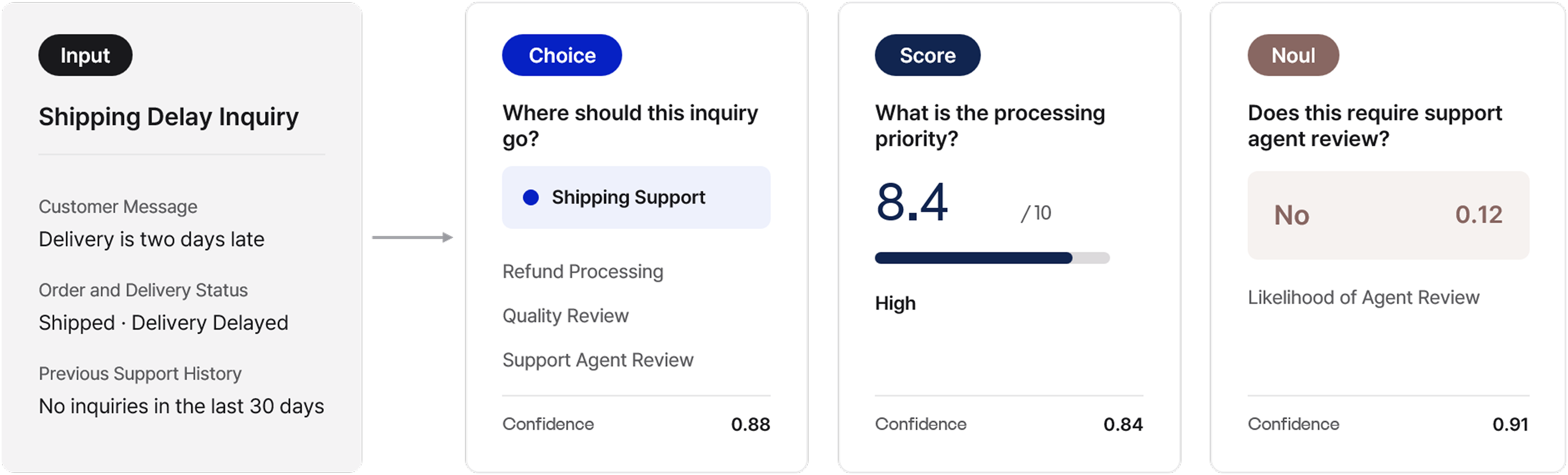
A shipping delay may look straightforward, but the system may still need to determine whether it is a standard delay, a refund request, a damaged shipment, or a delivery error. It may also need to score the urgency and decide whether a customer service representative should step in. Jev returns these decisions in three formats:
- Choice selects one option from a predefined set, such as shipping support, refund processing, quality review, or a customer service representative queue.
- Score places the case on a defined scale for urgency, customer impact, or handling priority.
- Noul estimates the probability that a stated condition is true, such as whether the case requires human review or may qualify as a policy exception.
Each result comes with probability and confidence values. The customer service system can use them to route the case or send it to a review queue. Deterministic checks, including refund windows and payment status, can remain in code. Customer service agents handle exceptions and decisions with material customer, financial, or policy consequences.
LLMs and Jev Serve Different Stages of the Workflow
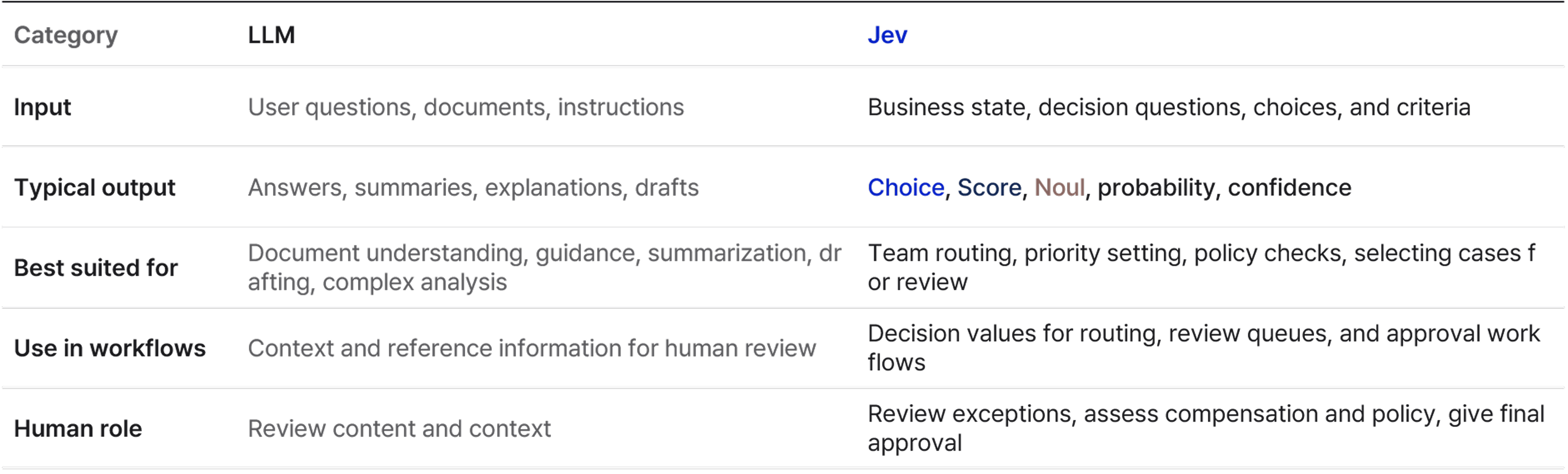
LLMs such as ChatGPT and Claude are well suited to reading a customer inquiry, explaining a delivery delay or refund process, and drafting a response. They can also summarize the relevant policy and provide the context a customer service representative needs.
Jev is designed for the decision point that follows. The business defines the available routes, questions, and criteria. Jev evaluates the inquiry against business context such as order status, shipping records, and support history, then returns structured values the workflow can act on.
How Classification-Focused AI Changes the Cost Structure
Using a high-performance LLM for every inquiry can become expensive as volumes rise. Model calls, latency, and customer service representative review time all accumulate, especially when the workflow only needs a route, score, or yes-or-no decision.
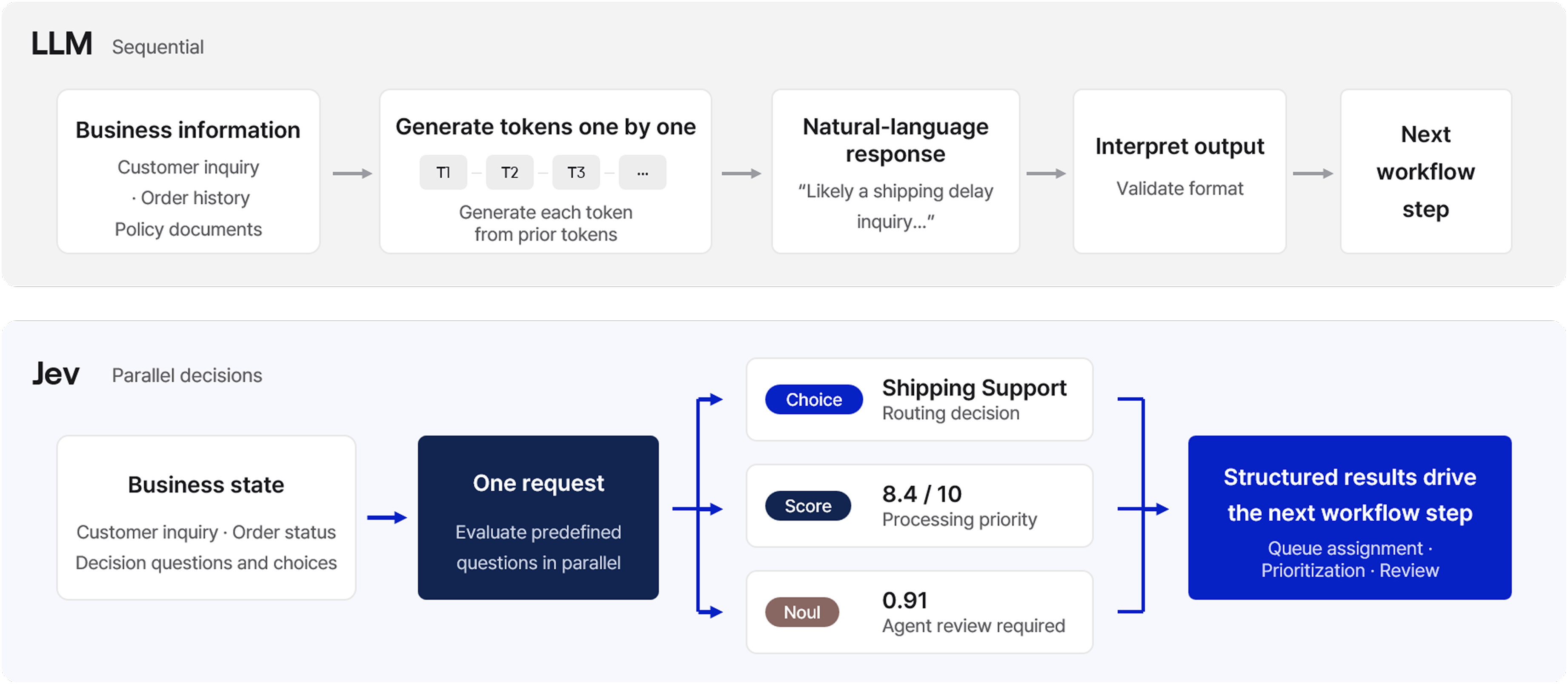
An LLM generates its response token by token. If that response needs to drive the next workflow step, the system may also have to extract the relevant value and check that it follows the expected format.
Jev evaluates predefined options and returns Choice, Score, Noul, and probability values in a structured format. It does not need to generate a long-form response for these tasks, which can reduce latency, output-token costs, and the post-processing required before the workflow moves forward.
For structured decision tasks, TypeSafe reports response times of 70 to 500 milliseconds. In its benchmark, Jev returned results 40 to 200 times faster than frontier LLMs, showing the potential latency advantage of a specialized model for classification and routing.
A complete view of operating cost includes the time from inquiry intake to team assignment, the share of cases classified manually, the number sent back for review, customer service representative editing time, and the final cost per resolved inquiry. These measures help enterprises see whether model placement is improving both processing speed and cost.
Model Routing: Matching Each Workflow Stage to the Right AI Model
Model routing sends each task to the model best suited to that stage of the workflow. In customer service, the choice can account for the required output, latency target, processing volume, consequences of an error, and need for human review.
A high-volume request with a clear handling path, such as a standard delivery status inquiry, can go to a fast classification model. An LLM fits stages that require an explanation of a complex customer situation or a drafted response. Refund exceptions, potential product defects, and customer safety issues can go directly to a customer service representative for review and approval.
The business also needs rules for deciding when a result can proceed automatically and when it requires review. Jev provides probabilities for defined conditions and a confidence score for each result. Company policy then determines the next action. A clearly identified shipping inquiry can move to the appropriate queue, while compensation requests and possible product defects go to a customer service representative. Safety concerns and potential recalls should follow a dedicated review path regardless of confidence.
When confidence thresholds and review rules are managed in the workflow layer, teams can adjust the scope of automated handling without retraining the model. They can then assess the effect through model call volume, average handling time, transfers to customer service representatives, and reprocessing rates. Together, these metrics show how model placement affects service quality and the cost of resolving each case.
Operating Principles for Enterprise AI Models
1. Jev turns classification into structured workflow input.
In customer service, Jev can return the inquiry type, priority, and handling route in a format the workflow can use directly. At high volumes, this can shorten classification and routing time while directing customer service representatives to the cases that need their attention.
2. LLMs and Jev can take distinct roles in the same workflow.
An LLM can interpret the context of an inquiry and produce an explanation or response. Jev supplies the decision values needed for classification and routing. Code verifies deterministic rules, while people review exceptions and decisions with significant consequences. This division of roles gives enterprises a clearer basis for model operations.
3. Model placement shapes the cost of enterprise AI.
Enterprise AI costs reflect model calls, processing time, repeated reviews, and the conditions that require human involvement. Jev adds a specialized option for classification-heavy workflows, giving enterprises more control over the balance among quality, speed, and cost.
Enhans evaluates model quality, latency, cost, and control requirements within a single operating design. This approach helps organizations place the right model at each workflow stage and define where human judgment is required, so they can connect AI use to measurable business outcomes.

in solving your problems with Enhans!
We'll contact you shortly!