



Financial institutions accumulate a wide range of documents, including policy terms, product disclosures, insurance payout criteria, lending guidelines, contracts, and applications. Each document may follow a different format and writing convention. Information needed for a single business task can also be spread across multiple files and pages.
Many financial organizations begin their AI initiatives by using OCR to extract characters from documents, then connecting the extracted text to RAG so the system can search for relevant documents and generate answers. OCR helps identify the words on a page, while RAG can quickly retrieve related passages.
Financial work often requires more context than a relevant passage can provide. Teams need to understand which conditions apply to a number, how clauses relate to exceptions, how products connect to riders, how amounts relate to coverage periods, and how information from several documents fits together. The retrieved information must preserve its conditions, business context, and source so AI can support queries and comparisons used in real workflows.
For financial AI to operate in production, document information needs to be prepared in a form that can be reused in financial processes. That starts with understanding the structures and relationships embedded in financial documents.
Financial Documents Encode Meaning Through Structure
Financial documents combine running text with headings, body copy, tables, footnotes, clause numbers, graphs, formulas, and images. In many cases, layout and reading order determine what the information means.
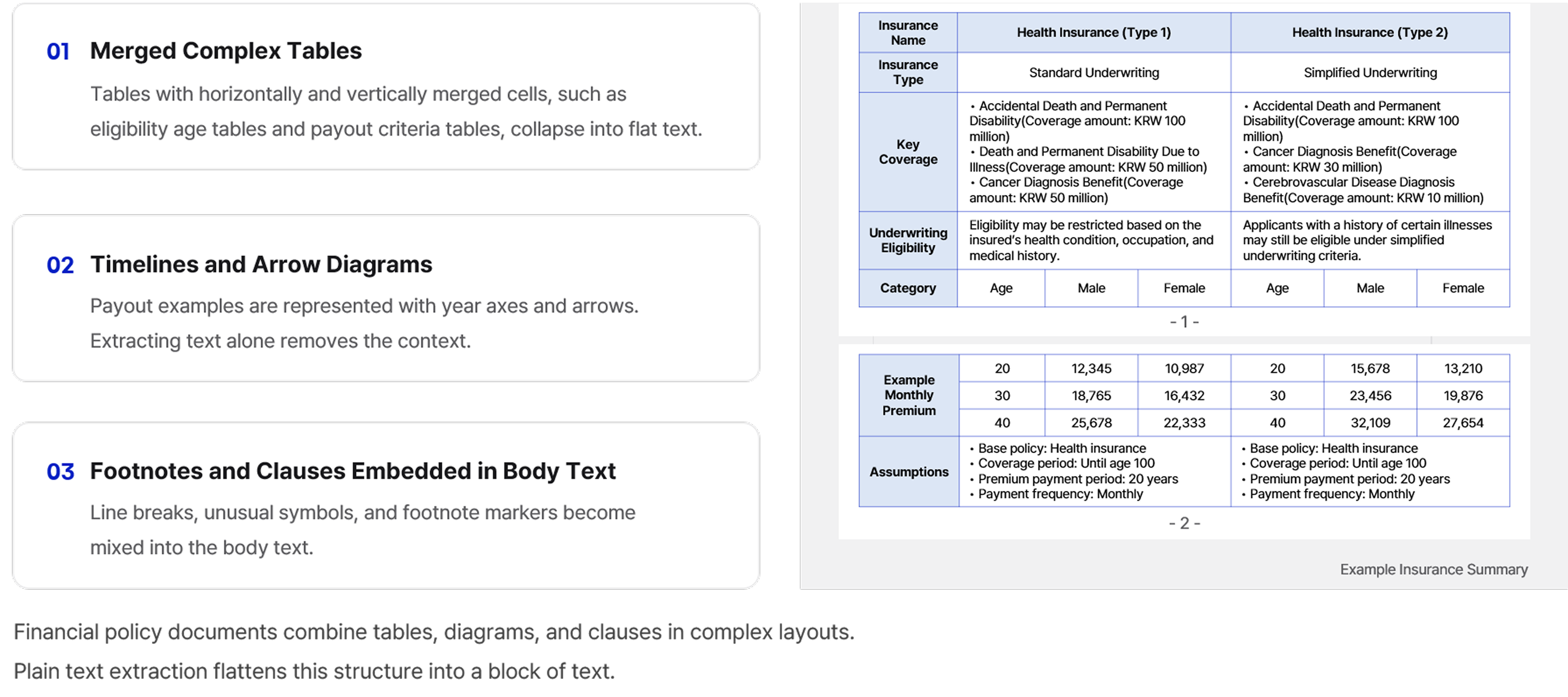
An insurance product may be documented across a standard product methodology document, a product summary, and policy terms. The product summary may describe the main coverage, while the policy terms define payout conditions and exclusions. Separate documents may contain eligibility requirements or rider details.
A value in a table may depend on a specific age, enrollment period, or coverage condition. A footnote inserted into the body may define an exception to the surrounding rule. A table that continues onto another page or a condition distributed across multiple documents may need to be reviewed together to understand the full product.
Extracting characters without preserving their position and relationships can remove the reading order and context needed for review. Financial document parsing must therefore preserve the structure and conditions in which information is used.
The Enhans Unstructured Document Parser Preserves Financial Structure and Relationships
The Enhans parser recognizes financial documents based on their file formats and storage methods, then reconstructs the content in the order a person would read it. It restores the reading order of multi-column text and distinguishes table headers, body cells, and notes. Tables that continue across pages are connected into a single structure, while clauses, footnotes, formulas, and image-based information remain tied to the document context.
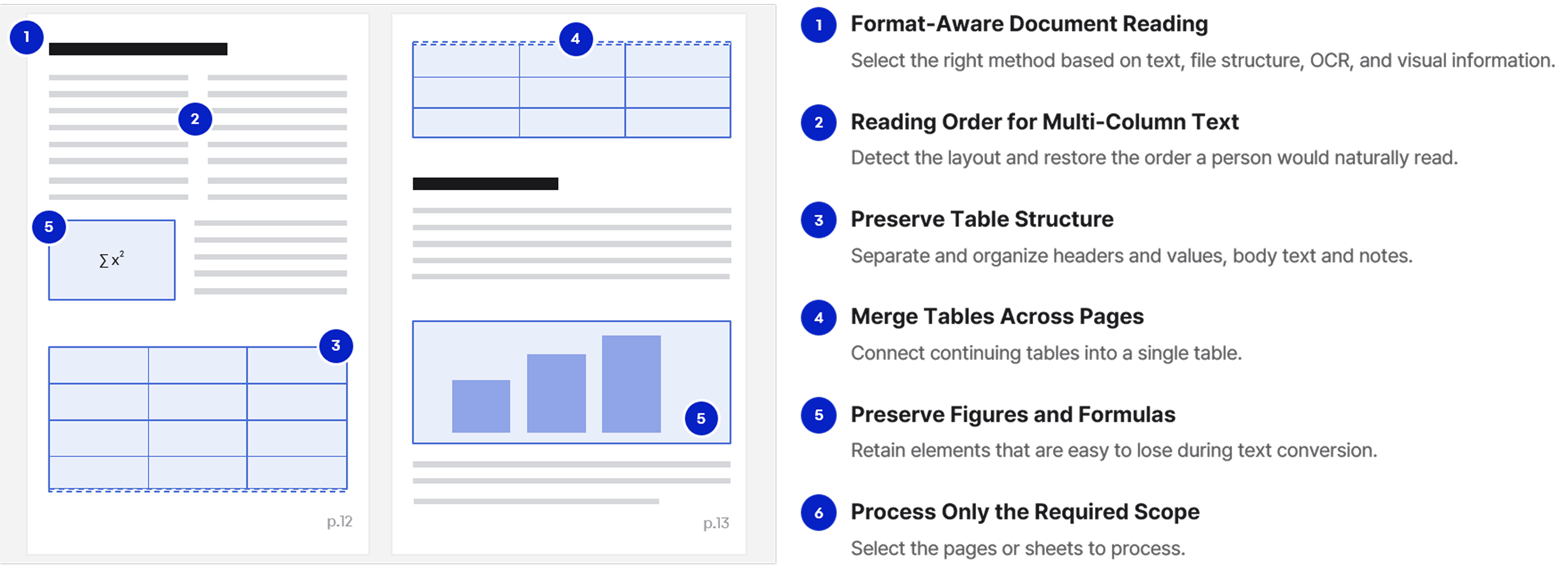
For example, an insurance table may use merged cells to represent eligibility ages and payout criteria. The parser needs to preserve which amount belongs to which age range and condition. A diagram that uses arrows to show timing and conditions needs to be interpreted as a sequence that can support business data. Its visual representation should remain available as context.
The extracted content is connected to information that financial teams repeatedly query, such as products, riders, coverage items, payout amounts, eligibility requirements, and coverage periods. Each item retains its source, including the document, page, table, or clause where it was found.
The result is a data structure that can support financial queries and comparisons. Its usefulness can then be tested against real business questions.
How to Validate Parsed Data Against Real Financial Questions
The usefulness of parsed documents depends on whether they can answer real business questions. Consider the following example:
Which insurance products are available to a 40-year-old customer, provide at least KRW 10 million in coverage for a specific disease, and renew annually?
Answering this question requires several pieces of information to work together. The system must check eligibility age, the relationship between the product and its riders, coverage for the relevant disease, the amount and unit of the payout, and the renewal period. It should also identify the document and page where each item is stated.
Structured parsing results can support searches for products that meet specific conditions, comparisons across coverage amounts, and filters based on age or period. Reviewers can examine the answer alongside its source documents.
A useful result should support recurring business questions and downstream workflows. Its accuracy, structure, source, and practical usability all need to be evaluated. Four criteria provide a practical basis for reviewing the quality of financial document parsing.
Four Criteria for Evaluating Financial Document Parsing Quality
Financial document parsing cannot be evaluated by character recognition accuracy alone. The output must support the queries, comparisons, reviews, and approvals that take place in financial workflows. Four criteria matter: content accuracy, structure preservation, downstream usability, and traceability.
Content accuracy means that numbers, dates, product names, clauses, and units match the source document. If a payout amount is extracted with the wrong unit, or the contract effective date is confused with the document creation date, the error can affect claim reviews and customer communications. The same applies to numerical terms such as loan rates, limits, and repayment periods.
Structure preservation means retaining the relationships between body text and tables, headers and values, clauses and footnotes, and entries that span multiple pages. A lending guideline may place approval conditions, exceptions, and applicable customer segments across separate tables and passages. Preserving these relationships allows AI to identify which criteria apply to a specific customer or product.
Downstream usability means that extracted data can support business questions and follow-up work. Data used for product comparison should also be available for insurance claim review, customer contract lookup, or lending review when those workflows require the same information. The value of parsing grows when teams can query and compare the same data across multiple processes.
Traceability means that a result can be linked back to the document, page, table, or clause that produced it. Financial workflows often require review and approval by a responsible employee. Reviewers need to verify the source and understand which conditions were applied so they can correct errors, respond to audits, and complete internal approval procedures.
Structured Data from Unstructured Documents Becomes an Operating Foundation Through Ontology
For parsed document data to be reused across financial workflows, it needs to connect to the concepts used by the institution. Products, contracts, customers, accounts, transactions, coverage conditions, and regulations need to be represented as business objects and relationships.
Ontology connects extracted document information to the objects, attributes, relationships, and rules used in financial work. This allows AI to locate the relevant text, identify how a product relates to a contract, determine which conditions apply, and trace the evidence behind a result.
A reviewer can examine the AI's retrieved result and its source documents, then approve the decision for use in subsequent workflows. Approved decisions can become additional data for future reviews.
Financial institutions evaluating AI adoption should review the data available to AI alongside model performance. When document content, structure, business relationships, and source evidence are connected, financial AI can support workflows such as information retrieval, comparison, and review.

in solving your problems with Enhans!
We'll contact you shortly!