



Ontology Lake: The Moment Data Becomes Meaning-Aware and Actionable
In Part 1 of the Ontology Series, we explored how unstructured data can be transformed into structured, meaningful data assets. In Part 2, we explained why ontology becomes the foundational structure that elevates LLM-based AI and AI agents to real-world, operational use. In Part 3, we examined how structured meaning and ontology connect directly to execution, and how this can be implemented within a unified platform. In Part 4, we addressed the debate around ontology and database systems, clarifying that the core issue in enterprise AI is not the choice of storage technology, but architectural design.
This article continues that trajectory. As the fifth installment in the series, it focuses on how ontology is implemented within an actual data platform and why this becomes the core infrastructure that enables AI execution.
Data Is Abundant. So Why Are Questions Harder to Answer?
In modern enterprise environments, data is no longer scarce. Logs, events, and transactional data generated across multiple systems are continuously accumulating, and organizations now possess more data than ever before. Yet paradoxically, as data volume increases, answering meaningful questions becomes more difficult. This is not simply a limitation of data processing capabilities, but a structural issue rooted in the system’s inability to understand what the data actually means.
Questions such as the following are still resolved by humans rather than systems:
- What does this data represent?
- How is this dataset related to another?
- How should this result be interpreted in a business context?
Data exists, but meaning remains external to the system. As a result, analysis slows down, interpretations diverge across teams, and even when AI is introduced, it often fails to translate into real execution.
At its core, the problem is not the volume of data, but the absence of embedded meaning.
What Current Data Architectures Fail to Solve
Existing data architectures have attempted to address this problem through different approaches, but none have fully resolved it.
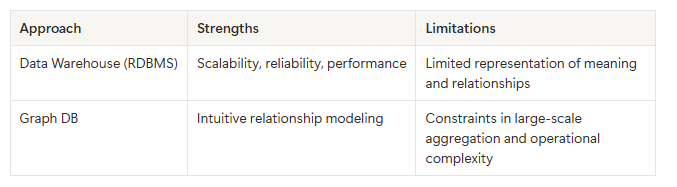
Relational systems excel at numerical processing and aggregation but do not inherently capture meaning. Graph systems represent relationships effectively, but struggle to meet the full set of requirements in enterprise environments.
As a result, many organizations operate fragmented architectures where data storage, analytics, and relationship exploration are handled by separate systems. This leads to a persistent disconnect where data exists, but meaning and execution remain unintegrated.
Ontology Lake: Embedding Meaning into Data
Ontology Lake addresses this disconnect by explicitly introducing a semantic layer on top of data. COS Ontology Lake defines business domain concepts and relationships as metadata, and integrates them directly with underlying data to form a unified structure.
Its core components can be summarized as follows:
- Class: Defines business entities
- Property: Defines attributes and their meaning
- Link: Defines relationships between entities
This is not simply a data modeling technique, but a way of translating an organization’s business language into a system-understandable structure. The ontology metadata operates in conjunction with SQL-based data, preserving the performance and scalability of existing infrastructure while enabling relational structures to be expressed and reconstructed as graphs.
Data is also managed through the following architecture:
[Query Interface(SQL/Cypher/Natural Language]↓
[Semantic Layer (Ontology)]
↓
[SQL Engine Layer]
↓
[Result: Table + Graph]
Within this structure, ontology is not merely descriptive. It acts as the core layer that connects data interpretation to execution.
Meaning Drives Queries and Completes Results
In an Ontology Warehouse, the way queries are constructed fundamentally changes. Users no longer need to design table structures or manually define JOIN conditions. Instead, queries are expressed in terms of business relationships.
For example, when querying the relationship between Person and Company, the system automatically performs the following steps:
- Maps tables based on Class metadata
- Resolves JOIN paths using Link definitions
- Generates and executes optimized SQL
This process is handled by the Semantic Query Compiler, which translates user intent into executable data operations.
The result is also transformed. Instead of returning a flat table, the system reconstructs the output as a graph using ontology metadata.
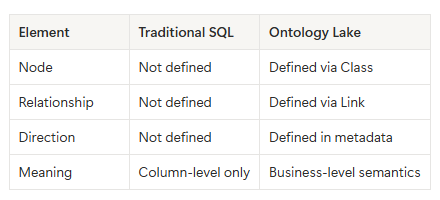
Even when relationships are not explicitly specified, the system infers and completes them based on the ontology structure, ensuring consistent and meaningful results.
From Data to Execution: Enabling AI to Act
The value of this architecture becomes most evident when combined with AI. In traditional environments, AI systems are effective at reading and summarizing data, but struggle to understand its structural meaning, limiting their ability to drive real execution.
With an Ontology Lake, the workflow becomes significantly more powerful:
Natural language request
→ Semantic interpretation (Ontology)
→ Query generation (SQL / Cypher)
→ Result with embedded meaning
→ Actionable output
In this flow, AI moves beyond passive interpretation and becomes capable of producing outputs that can be directly used within operational workflows. Data is no longer a static resource for analysis, but an active foundation for execution.
Conclusion: Data Platforms Are Becoming Meaning Infrastructure
The evolution of data platforms is becoming increasingly clear. The focus is shifting from storage and processing toward embedding meaning into data, allowing that meaning to guide queries, interpretation, and execution.
Ontology Lake sits at the center of this transformation. When data carries embedded meaning, and that meaning drives how data is queried, interpreted, and applied, data ceases to be a passive asset and becomes an active driver of decision-making and execution.
In an era defined by data abundance, competitive advantage no longer comes from having more data, but from connecting and utilizing it meaningfully. Ontology Lake represents the starting point of that shift.

in solving your problems with Enhans!
We'll contact you shortly!