


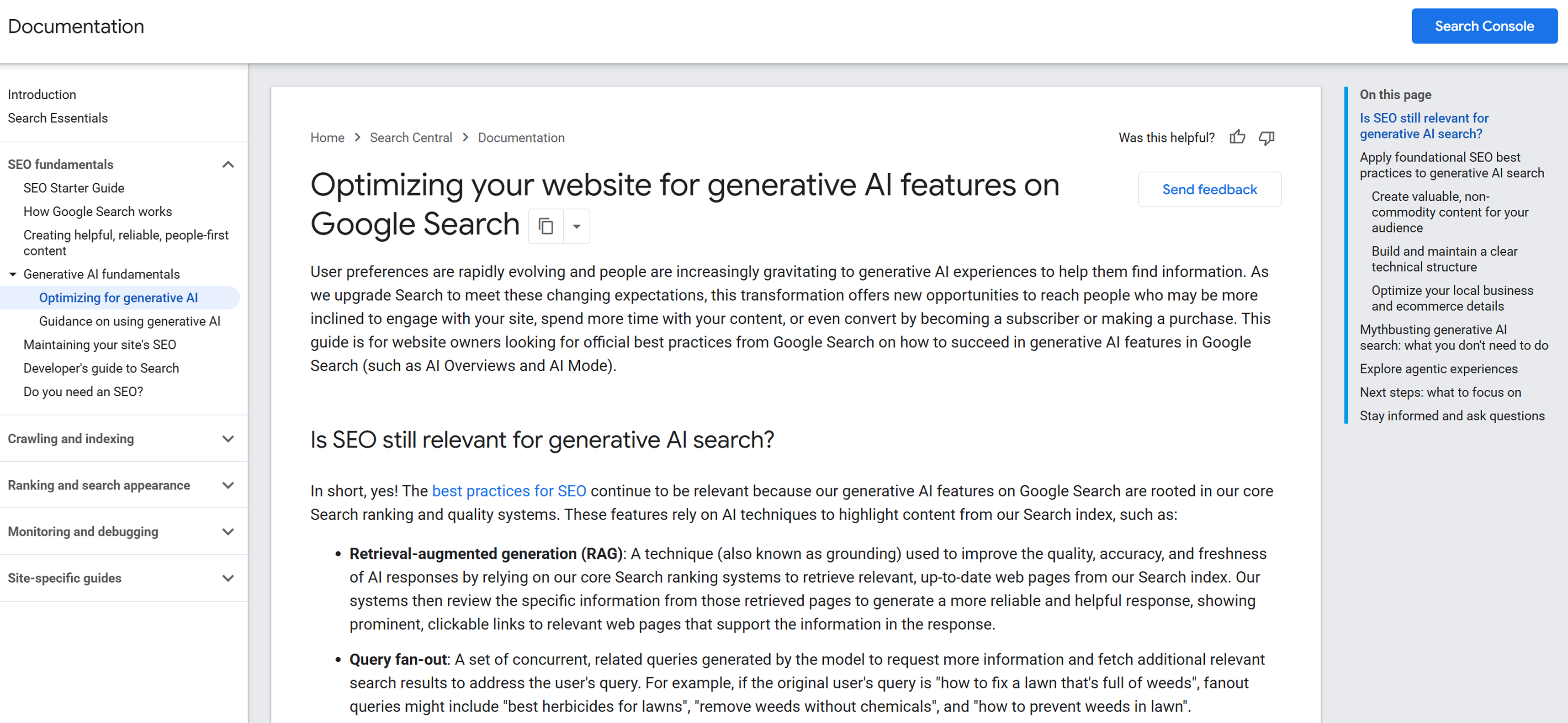
Last week, Google published its official AI optimization guide.
Then at Google I/O 2026, the scale of the shift was put into numbers. AI Overviews crossed 2.5 billion monthly active users. AI Mode surpassed 1 billion MAU within its first year. Google called it "the biggest change in 25 years of search."
Most marketers already know the research: organic click-through rates have dropped 61% as AI search has spread. With AI agents now operating inside the search interface around the clock, synthesizing information and delivering it directly to users, GEO (Generative Engine Optimization) has moved from optional to essential.
Against that backdrop, Google publishing its own AI search optimization guide carries real weight. It is Google explaining, in its own words, how brands get surfaced in AI search and under what conditions they appear in AI-generated answers. If you are thinking seriously about GEO, this document is worth reading.
After reading it, one question naturally follows.
"How do I actually find out how our brand is showing up in AI answers right now?"
How Is Your Brand Showing Up in AI Answers?
As AI search spreads, a consistent set of questions has started arriving from marketers. What does ChatGPT, Gemini, or Claude say when someone asks about our product? Does our brand come up before competitors? Is any of the information wrong?
These questions matter for a clear reason. Users no longer browse through multiple pages of search results. They read one AI-generated answer and make decisions inside it. If they need more, they follow the links or sources cited within that answer. How your brand is represented inside that answer now determines your competitive position.
And yet most marketers and brand managers cannot answer these questions clearly. Few organizations have any systematic process for collecting and analyzing AI answers. Most rely on typing into ChatGPT directly, or making judgments based on a single snapshot taken at one point in time.
What Google's Guide Actually Says: From SEO to AEO
Google's GEO guide covers three core points. All three align closely with what Enhans shared in a recent webinar.
First, AI answers are built from multiple sources.
Google explains that AI Overviews use RAG (Retrieval-Augmented Generation) and query fan-out to synthesize answers from many sources. For a single question, the AI references dozens of documents and combines the most relevant ones into an answer. If SEO was about ranking a specific page, GEO and AEO (Answer Engine Optimization) are about which sources the AI chooses when it builds an answer.
Second, originality and content quality are the primary variables for AI visibility.
Google explicitly states that "unique, valuable, non-commodity content" is the most important condition for inclusion in AI answers. The question is not how many keywords a page contains or how long it is, but whether it offers a differentiated perspective and real value that cannot be found elsewhere. This is a fundamentally different approach from keyword-driven SEO.
Third, AI Overviews change in real time.
Google itself acknowledges that AI answers change continuously, and that one-time optimization cannot produce stable results. If SEO allowed a page to hold a ranking for an extended period, GEO and AEO require ongoing monitoring and operations as a baseline assumption.
Why AI Answers Don't Change Even After GEO Optimization
Google's guide sets a direction, but it does not explain how to operate in practice.
- It says "create original content," but provides no way to verify whether AI answers actually changed after you did.
- It says "manage continuously," but does not specify what to measure, how often, or by what method.
- It says "multiple sources matter," but does not explain how to identify which sources are shaping your brand's AI answers.
The direction the guide points toward is correct. But moving in that direction requires measurement first. Without measurement, there is no improvement.
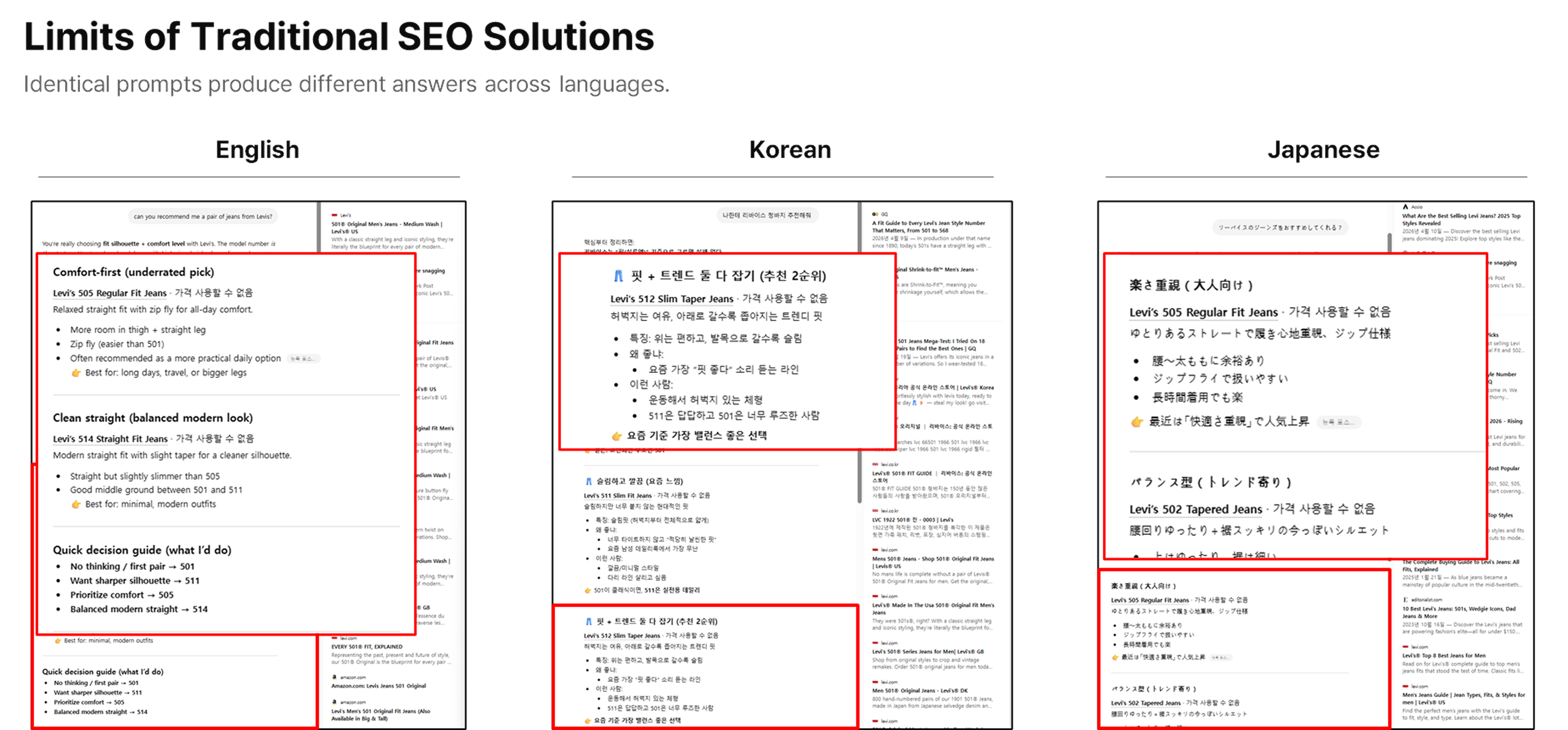
Measuring AI answers is more complex than it looks. The same question produces different answers across different engines. Within the same engine, results shift based on query type, language, country, and the moment of execution. Judging from a single snapshot taken at one point in time means missing the full picture of what GEO actually looks like for your brand.
What Analysis of Tens of Thousands of Prompts Revealed
Enhans collected and analyzed tens of thousands of prompts across multiple languages, multiple countries, multiple AI engines, and multiple personas. Here is what the data showed.
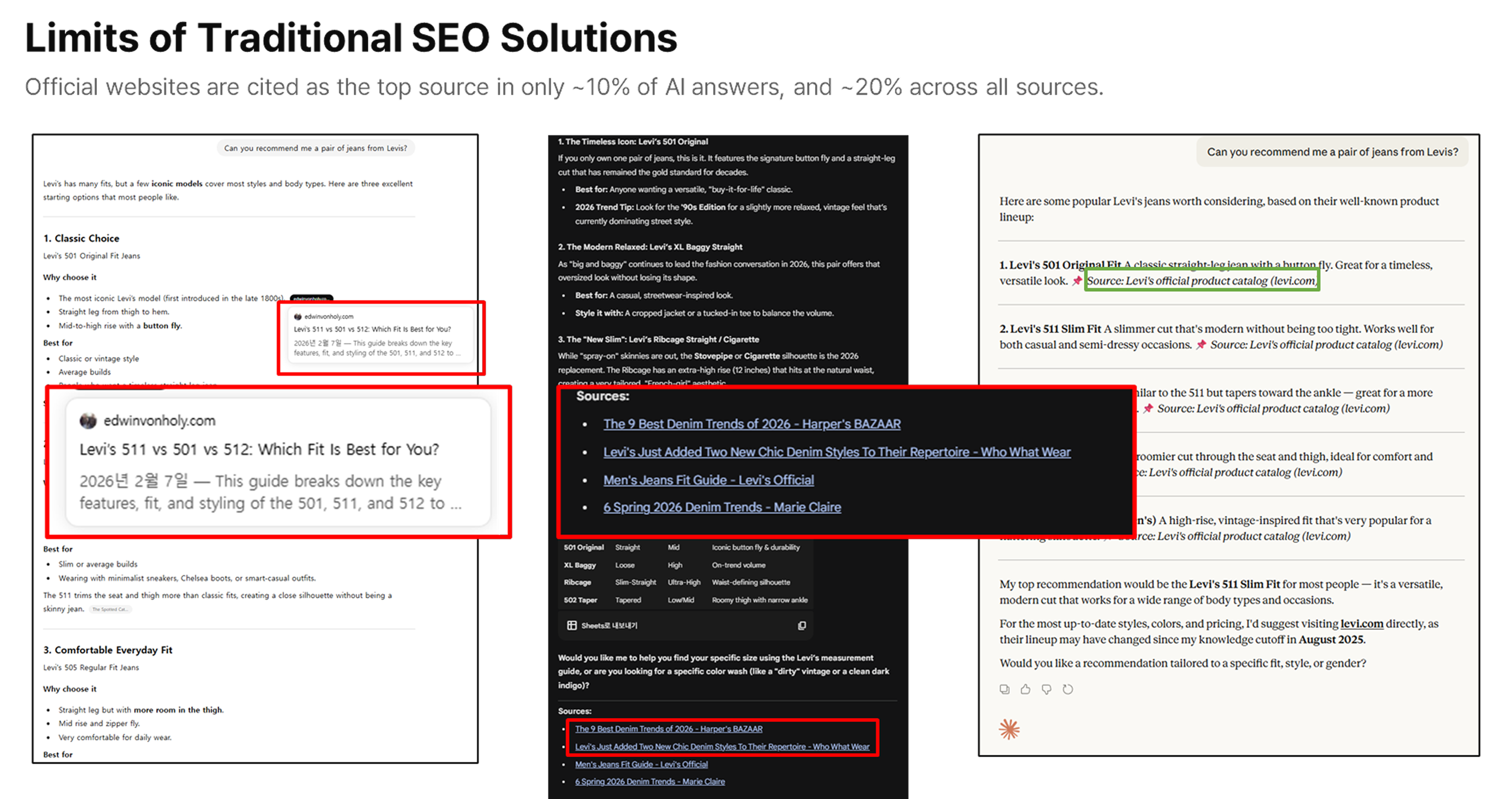
80% of AI answers are shaped outside your official website
A single answer draws from an average of nine or more sources. Official websites account for roughly 20% of that. The remaining 80% comes from media coverage, external reviews, community posts, and similar content. This pattern is especially pronounced in product comparison and recommendation queries.
No matter how well-built your website is, the majority of what shapes your AI answer is decided outside your official channels.
Brand visibility shifts with query type
Even for the same brand, the structure of how it appears in AI answers changes significantly depending on prompt type. Direct brand queries tend to surface the brand at the top with high frequency. In comparison or recommendation queries, the rate of appearing as the first mention drops sharply.
The visibility structure when a customer searches your brand name directly is completely different from when they ask "which solution is best." Without knowing which query types leave your brand underrepresented, there is no way to know where to improve.
Answer structures are inconsistent across engines
For the same prompt, AI engines produce inconsistent answers.
In terms of source recency alone, gaps of several weeks or more were observed between engines. Source selection logic and answer construction vary by engine. Optimizing for a single engine cannot account for performance across the full AI search landscape.
Operations That Start With Measurement
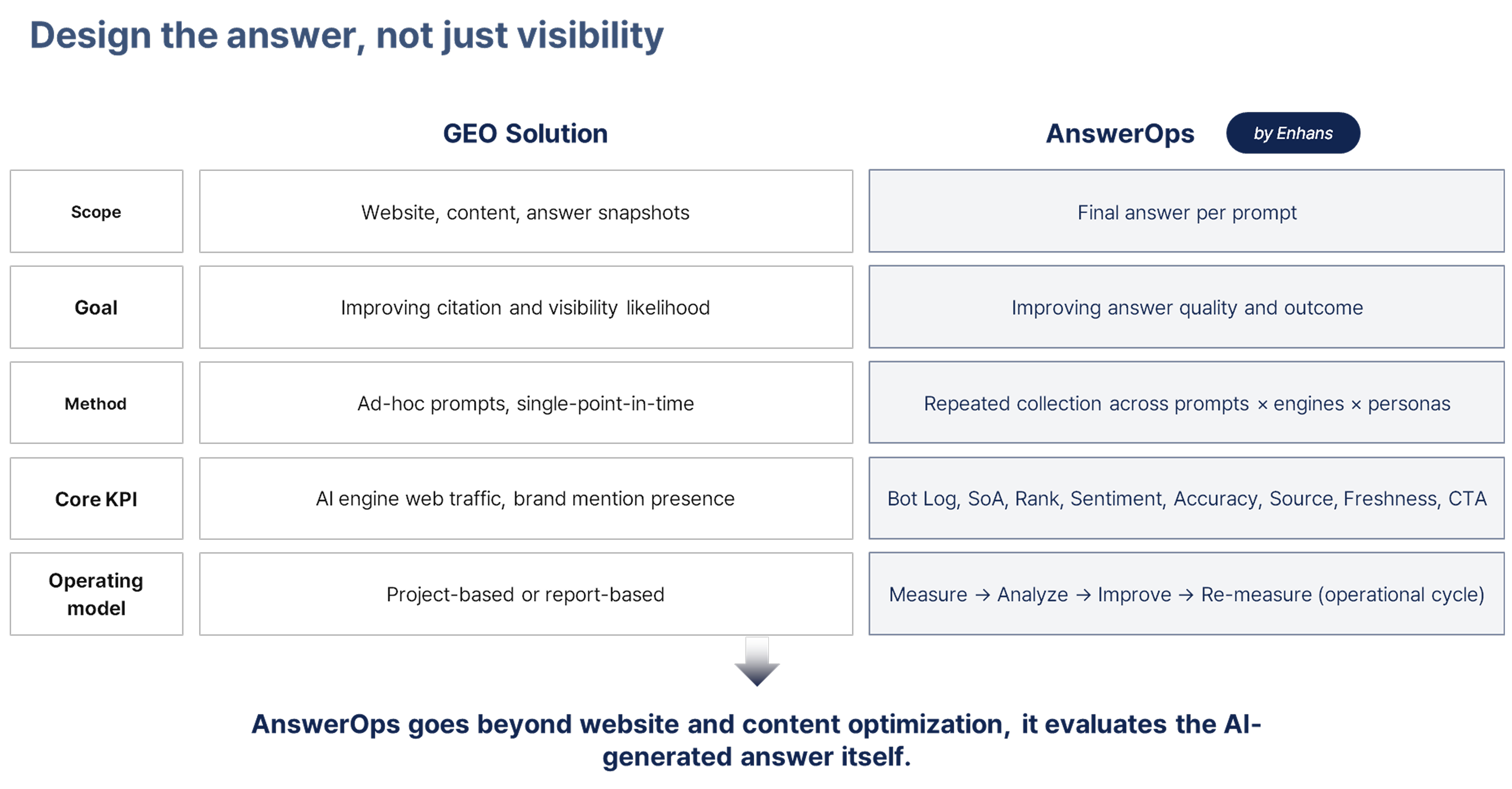
When Google says "manage continuously," the starting point of that management is measurement.
Which prompts surface your brand? In what order and with what weight does the answer describe you? Which sources are being cited? Is the message accurate? These questions have to be answered before an improvement strategy can be designed. Without this measurement, GEO becomes guesswork, or a report that never gets acted on.
Enhans AnswerOps is built around this operational structure. It connects answer collection, KPI analysis, improvement strategy design, execution, and re-measurement into a single loop.
The core KPIs are: Share of Answer (how much of the answer space your brand occupies), Answer Rank (where in the answer your brand appears), Source Citation (which sources are being used), Sentiment (the tone and reputation framing of the answer), and Message Accuracy (whether your brand message is being conveyed correctly). These metrics are tracked repeatedly across multiple prompts, multiple engines, and multiple personas.
This is not a one-time report or a single consulting engagement. In an environment where AI answers change in real time, the operational structure itself is the competitive advantage.
The Unit of Competition Has Changed
The competitive metric used to be which keyword, at what ranking position. Spending more on ads moved the ranking up, and that ranking connected directly to business outcomes.
In AI search, that structure has changed at a fundamental level. Users read one AI-generated answer instead of browsing a results page. The unit of competition has moved from page to answer.
The organizations moving ahead in this environment are not the ones that read Google's guide. They are the ones with data on how their brand is being described in AI answers, and what is actually showing up.
Enhans collects real AI answers across multiple engines and multiple personas, and analyzes brand answer performance against the five AnswerOps KPIs.

in solving your problems with Enhans!
We'll contact you shortly!