



Financial institutions are expanding AI from customer service and document search into compliance, risk management, underwriting, and product recommendations. These workflows involve decisions and accountability. As AI becomes part of day-to-day financial operations, institutions need a way to verify the data and criteria behind each answer.
In an Enhans survey of approximately 150 financial services professionals, AI hallucinations and answer reliability emerged as the most frequently reported challenge. It was selected by 55.7% of respondents. Other major challenges included converting unstructured documents into usable data, managing security, permissions, and audit requirements, and finding terms, regulations, and internal guidelines spread across different systems.
A closer look at the reliability issue revealed three recurring concerns: answers that contain inaccurate information, answers without clear sources or supporting evidence, and answers that fail to understand the context of financial work. These issues force employees to return to the original documents for verification. They also raise concerns that inaccurate answers could affect internal reporting and risk response.
In financial services, these errors can create direct business and compliance risks. Incorrect guidance on terms or product conditions can lead to suitability concerns, customer complaints, and regulatory scrutiny. Inaccurate information used during underwriting can affect the reliability of lending or insurance decisions and weaken risk management. Incorrect figures in regulatory reporting or internal decision-making can increase the burden of audit and compliance work.
Repeatedly checking AI-generated answers against source documents can leave review workloads unchanged. It can also affect adoption and the return on AI investment. Financial institutions need to verify the evidence and criteria behind an answer and trace how an error occurred as part of the operating process.
Financial Work Requires Multiple Data Sources and Criteria
The financial workflows being considered for AI adoption share a common challenge: different data sources and documents must be interpreted together across customers, accounts, transactions, contracts, products, and regulations.
A lending review may require a customer's income and credit information, existing contracts, repayment history, and product-specific approval criteria. An unusual transaction review may involve the relationship between a customer and an account, transaction patterns, risk signals, and previous investigation records. An insurance claim review may require the incident details, insurance contract, coverage, exclusions, submitted documents, and payment criteria.
The information required for these decisions rarely sits in one place. Core banking systems and lending or insurance contract tables contain structured data. Loan applications, financial statements, insurance claim documents, and internal guidelines contain unstructured information. Review records and employees' experience handling exceptions also influence how decisions are made.
Retrieving the data does not resolve the decision. The system also needs to determine which customer and contract are related, which regulation applies to a product, which value should be used among several figures, and how an exception should be handled. Financial AI therefore needs a way to connect data, documents, and business criteria within a single decision structure.
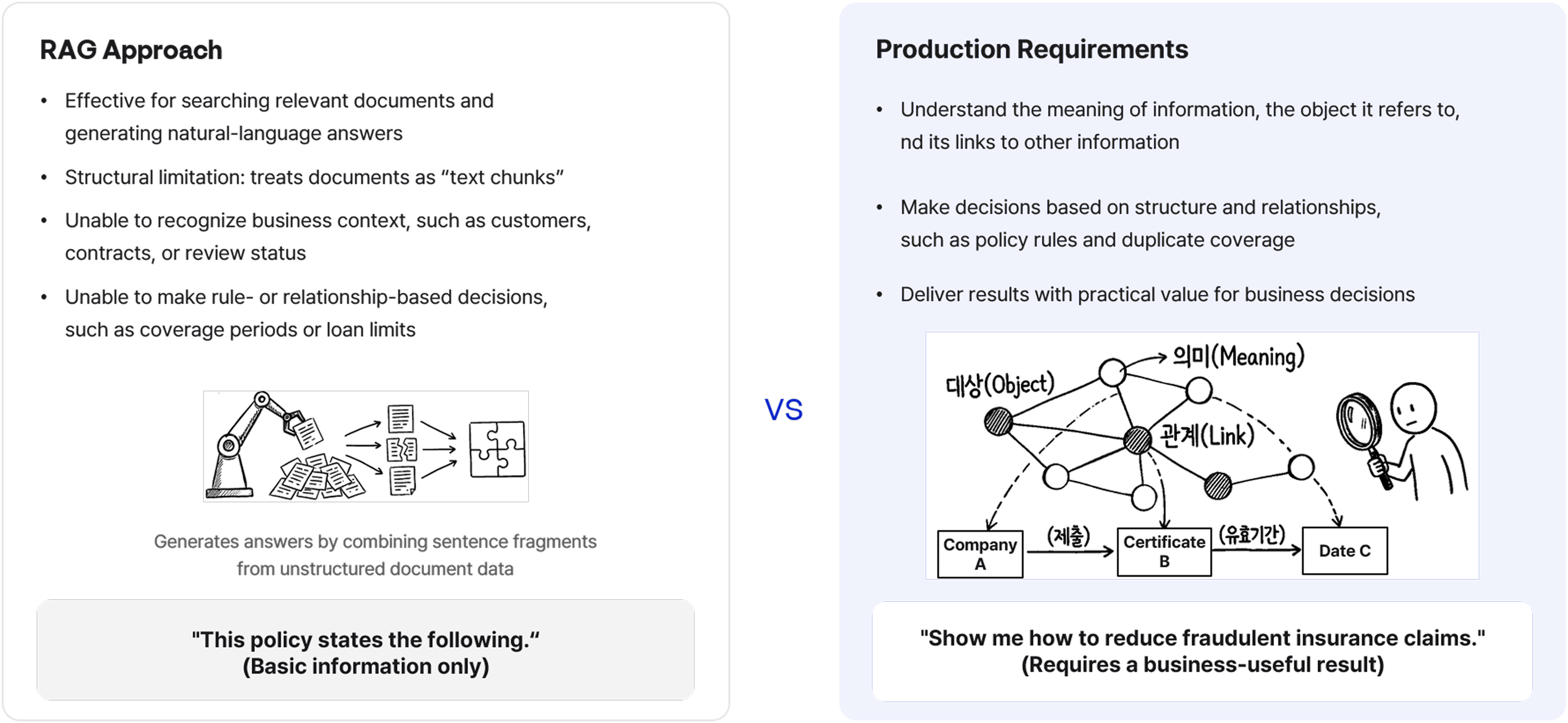
Why RAG-Based Financial AI Can Miss Business Context
Retrieval-augmented generation, or RAG, searches for documents related to a question and generates an answer from the retrieved content. It can be useful for finding a specific clause in a policy or summarizing a defined document. Financial work often requires several data sources and criteria to be considered together.
What was the interest rate on the loan signed on February 13, 2025, and which loan product had the highest sales?
Answering this question requires a definition of the date being used. The data collection date, record registration date, and actual contract date may be different. The interest rate could refer to the base rate, the rate applied to the customer, or the maximum rate. The product name and sales volume also need a clear aggregation rule.
Document relevance alone does not tell an AI system which date, rate, or aggregation rule applies. The system may reference the wrong date or interest rate, or combine figures calculated under different criteria into a single answer. The meaning of financial data can change depending on the business purpose of the question, and differences in departmental criteria make the problem more difficult.
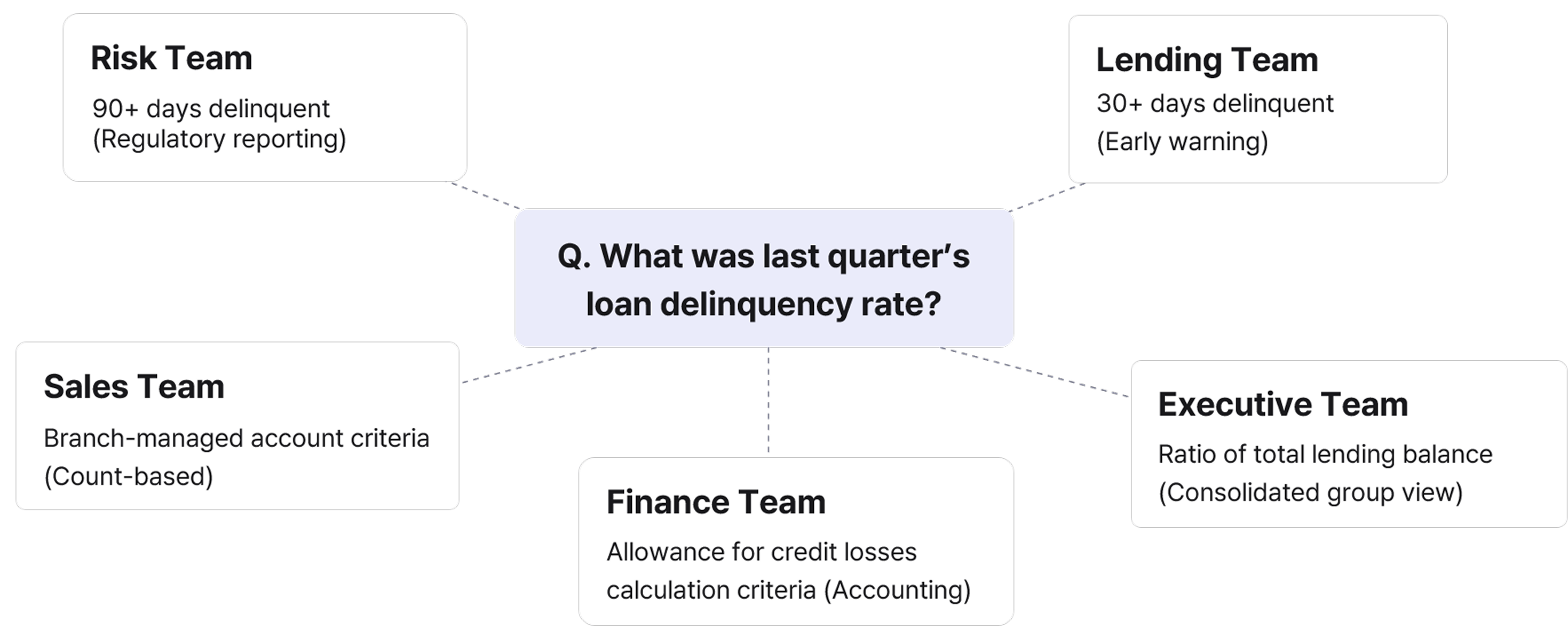
Financial Terms Have Different Definitions Across Departments
The same term can be used differently depending on the purpose of a department's work. When asked for the delinquency rate for the previous quarter, a risk team may use a 90-day delinquency threshold, while a lending team may use a 30-day threshold for early warning. Finance may use a provisioning standard, while executives may look at the ratio relative to total outstanding loans.
Interest rate terminology also varies by use case. The base rate, applied rate, preferential rate, and maximum rate represent different conditions. If a customer contract requires the applied rate, referencing the base rate or maximum rate could lead to errors in customer guidance and underwriting results.
Financial AI needs shared definitions for common concepts and explicit rules for distinctions across departments. It also needs to show which data and rules were applied so that employees can verify the result before using it in their work.
Ontology Connects Financial Data with Business Criteria
An ontology structures the objects, attributes, relationships, and knowledge used in financial work. It defines customers, accounts, contracts, transactions, and financial products as business objects, then connects attributes such as amounts, rates, balances, and status with relationships and rules for underwriting, delinquency, and approval.
For example, an ontology can represent the relationship between a customer and an account, the transactions associated with an account, a loan contract held by a customer, and the rate, limit, and repayment terms attached to that contract. With this structure, AI can interpret individual data values together with the business objects connected to them.
Building an ontology starts with the institution's workflows and decision processes. That process traces how data and implicit criteria are used across databases, documents, files, external sources, and employee experience. Enhans's Forward Deployed Engineers identify these connections through interviews with business users and system analysis. They then structure the data, implicit knowledge, business objects, relationships, and rules so AI can reference the context of financial work.
Source data can remain in existing systems while an ontology layer connects its meaning and relationships. This allows financial institutions to keep their current systems in operation while adding the structure AI needs to interpret business data.
How Ontology Supports Insurance Claims Review
Insurance claims review is a common financial workflow that requires multiple documents and business data to be considered together. A claim form may include the date and type of an incident and the resulting damage. An insurance contract contains coverage, eligibility conditions, and exclusions. To determine whether a claim should be paid, the reviewer needs to check whether the incident is covered, whether additional documents are required, and whether the case requires further review against previous decisions.
An ontology connects the relationships among claims, contracts, customers, incidents, coverage conditions, and payment criteria. AI can use this business context to retrieve relevant information and suggest claims that require review together with the supporting evidence. An employee can then review the evidence, internal criteria, and previous cases before deciding on payment and follow-up actions.
The same structure can support lending reviews by connecting customers, contracts, and repayment history. It can also support unusual transaction reviews by bringing together customers, accounts, transaction patterns, and risk signals.
Managing Changing Financial Regulations and Business Criteria
Operating financial workflows in production requires a way to reflect current business criteria and continuously manage new regulations and product changes.
Financial institutions add new products, regulations, and internal standards over time. The ontology needs to incorporate these changes as part of the operating model so AI can reference the current criteria.
When a regulation changes, the institution needs to track its effective date, previous versions, and the AI workflows affected by the change. It should also be possible to trace which regulation and data supported an AI answer at a specific point in time. This traceability supports audit and internal review.
With change history in place, financial institutions can update the relevant parts of their AI operating model as criteria evolve. They can also identify the basis for work completed under previous standards and the workflows affected by a new regulation.
Measuring Financial AI Through Changes in Operations
Financial AI performance can be tracked through answer speed, the number of automated tasks, the traceability of decision evidence, and the speed of responding to regulatory changes. Institutions should also track how long employees spend finding the evidence needed for a decision and how consistently the same criteria are applied to similar cases.
Connecting an ontology with business criteria can support improvements such as:
- Less time spent finding data required for a decision
- Traceable evidence and decision processes for AI-generated outputs
- Faster responses to product and regulatory changes
- Lower initial design costs for new AI workflows
In financial operations, AI can propose candidate scenarios and supporting evidence. Rule-based validation and data integrity checks can follow, with experts reviewing and approving the result. Approved decisions can then be used in the relevant workflow, while operating results become reference data for similar cases in the future.
When a financial institution evaluates an AI initiative, it needs to define which decisions should be structured, which data and criteria should be connected, and how employees will review the result. Each institution has different systems, workflows, and methods for managing regulations. A review of the actual business process should come first.

in solving your problems with Enhans!
We'll contact you shortly!