


Authors: Minhyeong Yu, Wonduk Seo*
Affiliation: AI Research, Enhans, Seoul, South Korea
*denotes corresponding author
Paper link: https://arxiv.org/abs/2604.23993
TL;DR
- EPM-RL is an on-premise product mapping framework for deciding whether two e-commerce listings refer to the same sellable SKU.
- The core idea is to distill expensive agentic reasoning into a trainable in-house model, so inference can run privately without external API calls or retrieval orchestration.
- The training pipeline combines teacher-generated reasoning traces, LoRA-based SFT, and GRPO with verifiable rewards plus three specialized judge agents.
- On an internal benchmark of 1K held-out product pairs across 500 brands, EPM-RL reaches 0.8120 F1, outperforming zero-shot, CoT, BM25 RAG, Multi-Agent RAG, and GPT-5.4 reasoning baselines.
Abstract
Product mapping decides whether two marketplace listings describe the same sellable product. This single signal powers price monitoring, catalog integration, promotion operations, and brand protection.
In real e-commerce data, similar titles do not always mean the same product. Two listings may share the same brand, product name, image, count, and dosage, yet differ by bundle composition, seller condition, option, or commercial SKU. A naive matcher can treat them as identical and incorrectly flag a seller as price-dumping.
EPM-RL addresses this by turning product mapping from a high-cost agentic pipeline into a single trainable on-premise model. Agentic reasoning is used during training, while deployment remains private, scalable, and simple.
Why Product Mapping Matters
Product mapping is a foundational signal in e-commerce operations. One decision, whether two listings describe the same product or not, supports several workflows at once.
For sellers, it enables fast competitor price monitoring. When the same SKU is sold at a different price, a pricing system can respond in minutes instead of days.
For consumers, it makes price comparison meaningful. The cheapest listing only matters when it is actually the same product, not a different bundle or option hidden behind a similar title.
For brand owners, it supports channel protection. MAP enforcement, grey-market detection, and margin-leakage analysis all depend on knowing whether listings map to the same SKU.
The hard part is that marketplace titles are written for search visibility, not clean catalog matching. Product mapping must reason over brand, model, variant, quantity, option, and bundle structure instead of relying on lexical overlap.
Method: EPM-RL
EPM-RL follows a training and deployment workflow that moves from Data to PEFT, GRPO RL, and finally an on-premise model.
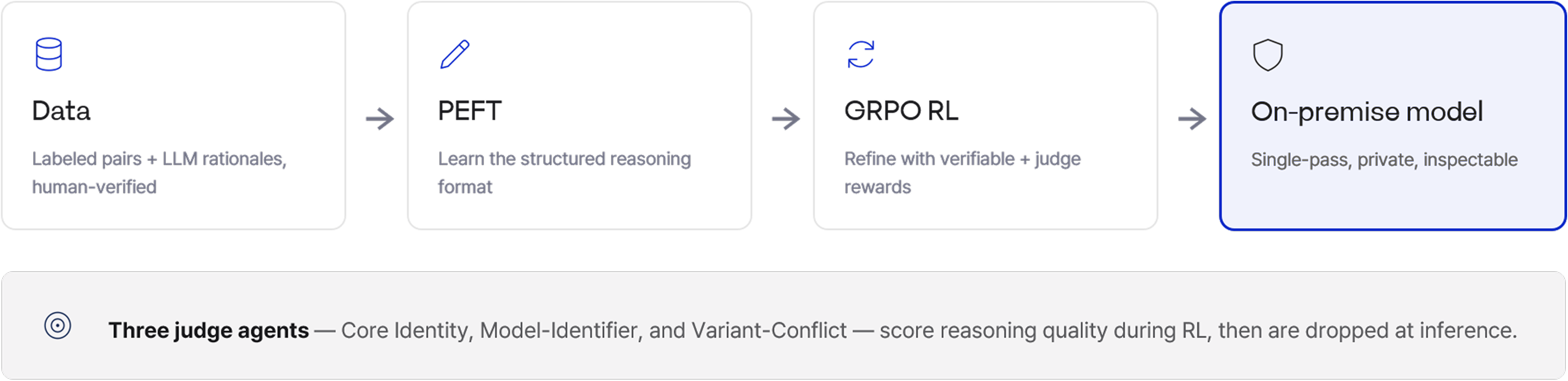
First, the framework builds a curated product-pair dataset. The paper describes approximately 12K labeled product pairs across about 500 brands, split into 6K examples for PEFT, 4K for RL, 1K for validation, and 1K for testing. A strong teacher model generates reflective reasoning traces from labeled pairs, while staying constrained to evidence in the two product titles.
Next, in the PEFT stage, a Nemotron student model is trained to produce structured reasoning followed by a final binary label. The reasoning format follows three steps: identify the core product, compare brand and model identifiers, then check variant attributes and bundle composition. This structure makes the model output inspectable and prepares it for reward-based training.
Then, in the GRPO RL stage, the policy generates multiple rollouts for each product pair. The system rewards outputs that follow the required format, predict the correct label, and produce grounded product-comparison reasoning. Once this reasoning behavior is internalized, inference runs through a single on-premise model rather than an inference-time agent pipeline.
Agentic Reward
The reward design mirrors the actual failure modes of product mapping.
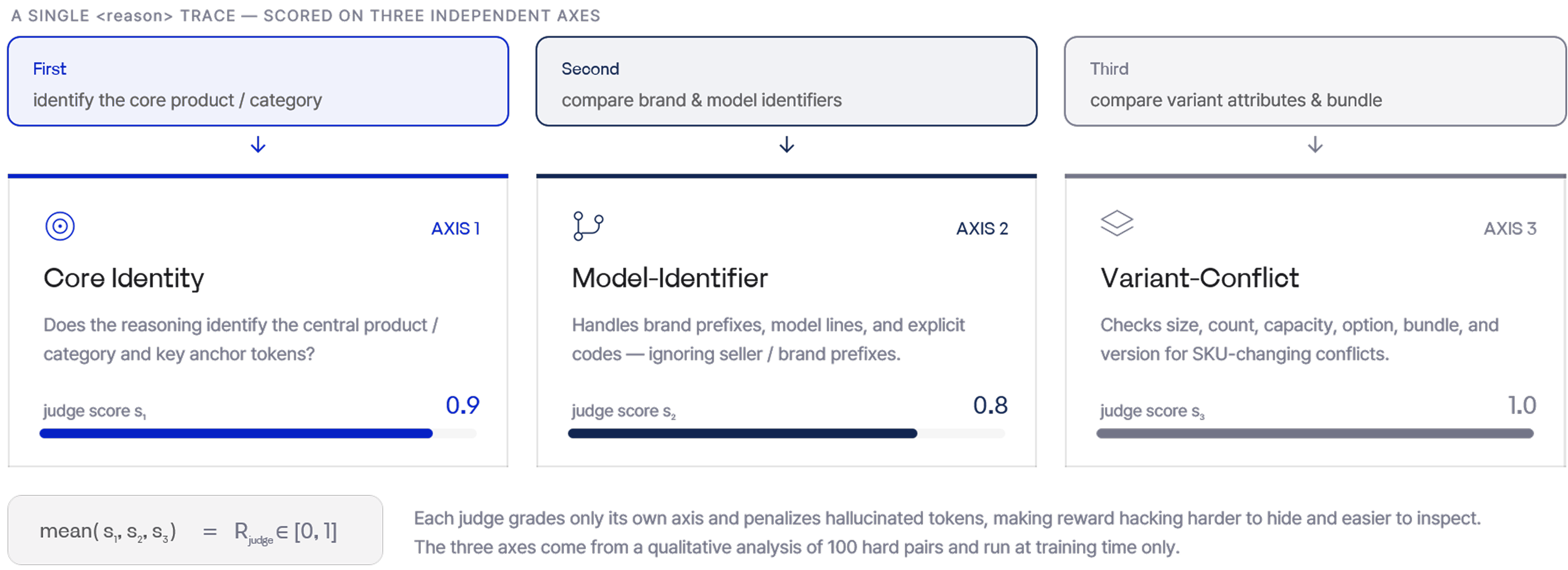
EPM-RL uses three specialized judge agents during training:
- Core Identity Judge: checks whether the reasoning identifies the central product or category.
- Model-Identifier Judge: checks whether the reasoning handles brand, model line, and explicit identifiers.
- Variant-Conflict Judge: checks whether the reasoning detects SKU-changing differences such as size, capacity, count, option, bundle, or version.
Each judge scores one sub-skill on a 0 to 1 scale. The judges penalize hallucinated tokens and weak generic reasoning. This prevents the model from being rewarded simply for producing longer explanations.
The judges serve as training-time feedback only. At inference time, EPM-RL runs as one on-premise model without retrieval agents, coordinator agents, or external API calls.
Built on the Nemotron Stack
The implementation is organized around the NVIDIA Nemotron stack.
In the paper, the training setup uses NVIDIA's Nemotron model with Megatron-Bridge for LoRA fine-tuning, followed by LoRA-based reinforcement learning. This can be understood as a stack that moves from product-pair data, to data operations, to training components, and finally to the on-premise EPM-RL model.
This stack matters because the goal is not only higher benchmark performance. The goal is to make product mapping deployable at catalog scale, with private inference and predictable operating cost.
Results
On the internal 1K held-out benchmark, EPM-RL achieves the best F1 score among the compared methods.
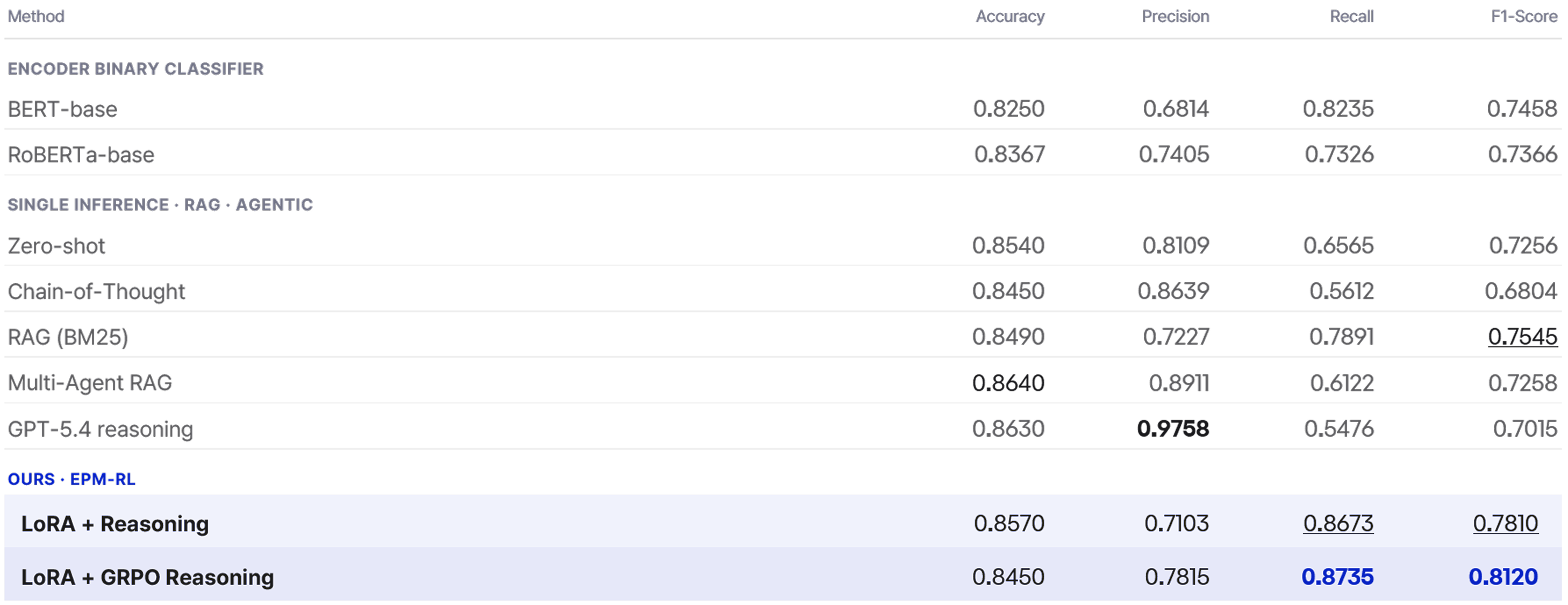
A key takeaway is that prompting a model to reason more does not automatically improve product mapping. CoT and Entity-Attribute prompting fall below zero-shot. GPT-5.4 and Multi-Agent RAG show strong precision but lower recall, which means they avoid some false positives while missing many true matches.
EPM-RL finds a stronger balance. It improves recall while keeping competitive precision, producing the best overall F1. The result suggests that structured reasoning is most useful when it is trained to be faithful and rewarded against task-specific product-matching criteria.
Inference Economics from an On-Premise Speed and Cost Perspective
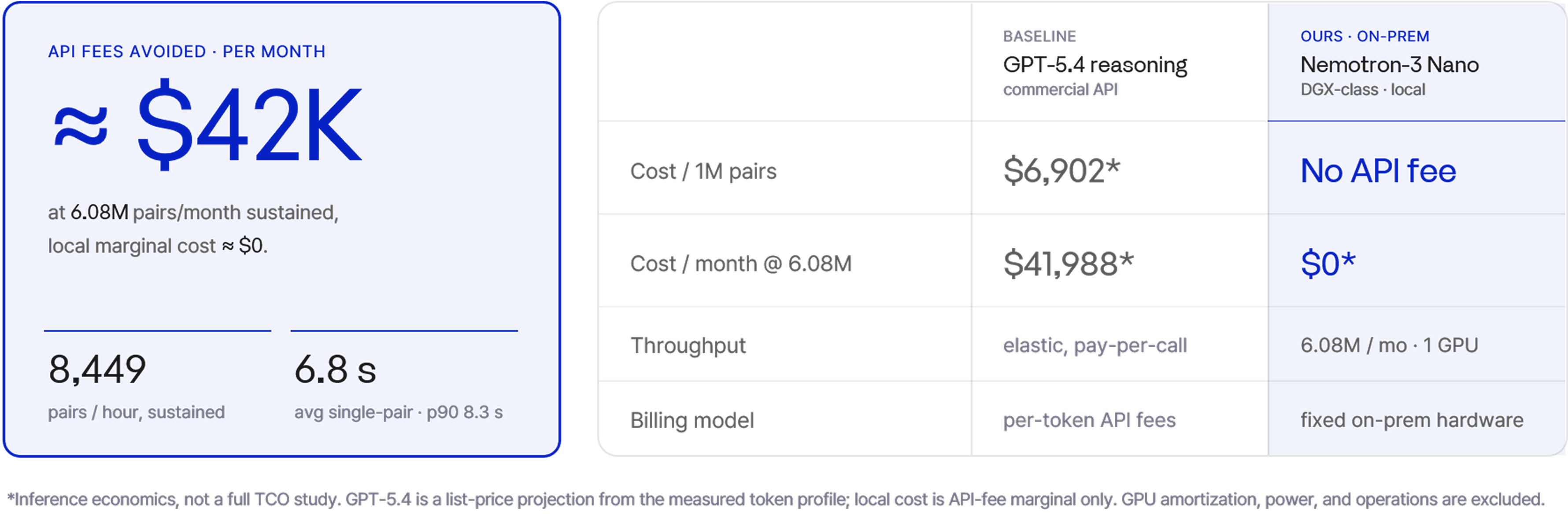
EPM-RL is not only about improving model performance. Product mapping requires repeated comparisons across large-scale product pairs, so inference cost and throughput become important criteria in real-world deployment.
This study benchmarks inference economics by comparing an external GPT-5.4 reasoning API against Nemotron-3 Nano served locally via vLLM.
Based on the token profile measured on the 1,000-pair benchmark, GPT-5.4 reasoning costs about $41,988 in API fees when scaled to 6.08M pairs per month. In contrast, the On-Premise setup does not incur per-call API fees at the same request volume, while sustaining throughput equivalent to 6.08M pairs per month on a single GPU.
Here, local cost of $0 does not mean the hardware is free. GPU amortization, power, and operational costs are excluded. It means that API billing is removed from each inference call. Even with that caveat, this comparison shows that EPM-RL can support both cost reduction and data control for large-scale product mapping.
Conclusion
EPM-RL shows how reinforcement learning can turn product mapping from an agentic inference pipeline into a production model.
First, decomposed judge rewards make reasoning more faithful. Core identity, model identifiers, and variant conflicts are evaluated separately, so the model learns the comparison behavior that matters for SKU-level matching.
Second, the system keeps agentic reasoning where it is most useful: during training. Once the reasoning behavior is distilled into the student model, inference becomes a single on-premise forward pass.
Third, the deployment path fits enterprise constraints. Catalog data stays inside the environment, API dependence is removed, and large-scale product matching becomes easier to operate across price monitoring, promotion, and brand-protection workflows.

in solving your problems with Enhans!
We'll contact you shortly!