


The attention around GPT 5.6 shows how quickly competition at the frontier of AI is moving. Every new model release pulls attention toward stronger performance, longer-horizon task execution, and broader tool access.
Enterprises are not insulated from this momentum. Each more powerful model prompts organizations to reconsider which AI tools to adopt and what standards employees should apply when working with AI. In enterprise AI, the relevant questions go one step further. Organizations also need to determine which tasks AI can handle, which sources it should draw from, and who can judge whether the results are operationally sound.
When Public Administration Knowledge Becomes an AI Use Case
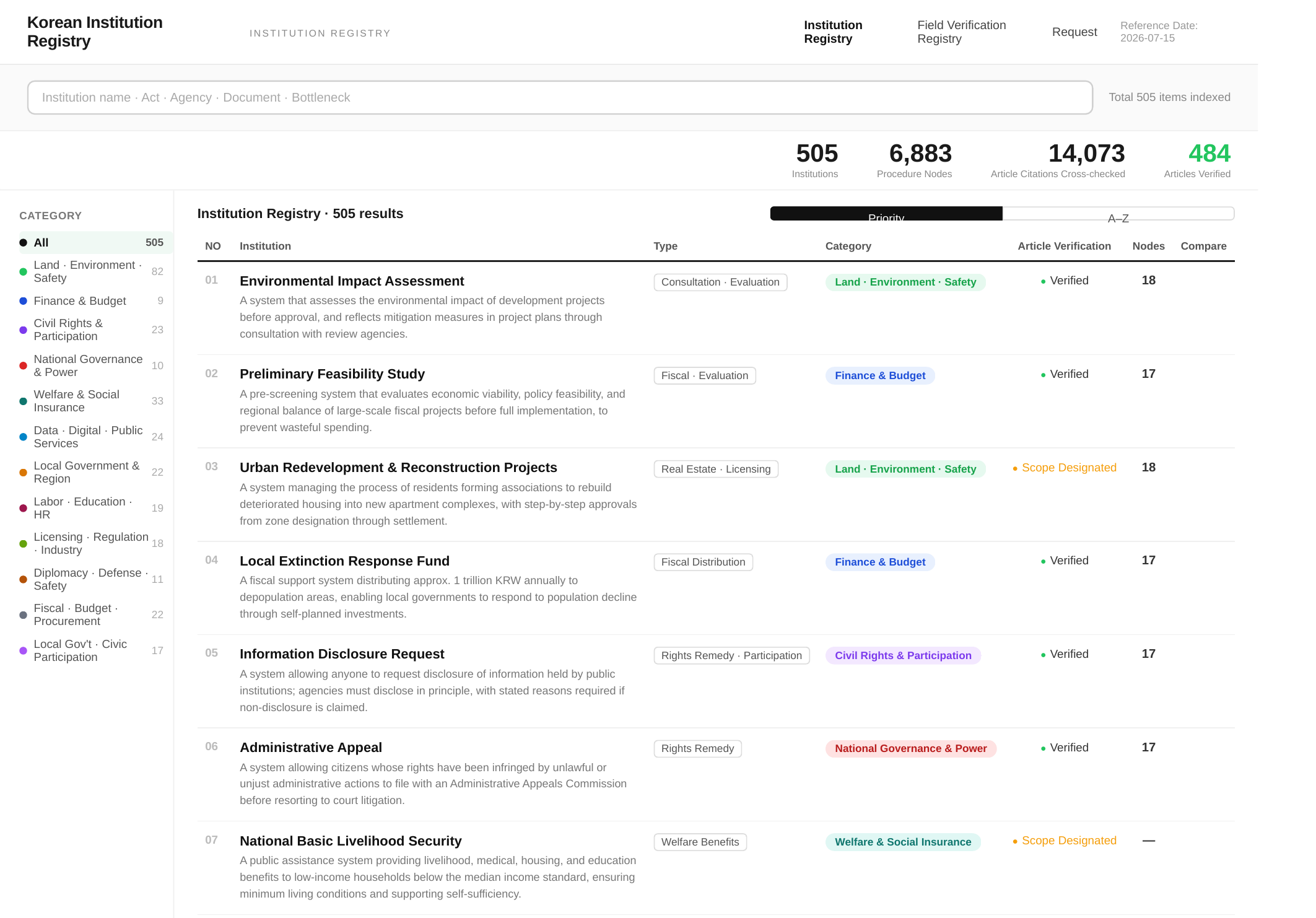
A recent open-source project on GitHub illustrates this clearly. A public administrator in Korea compiled more than 500 major government programs and policies into a single platform, organizing the laws, agencies, procedures, budgets, and documents for each into structured, single-page diagrams that people can actually read and use.
The scale of the project is impressive, but the more important point is how it was built. It was possible because someone with deep domain knowledge in public administration directed the AI. The person knew which laws to treat as the authoritative source, which agencies and procedures connect to each other, and which budget items belong in the picture. That understanding shaped how they asked questions of AI, reviewed results, and refined the structure.
When Physics Knowledge Reveals the Limits of AI-Generated Code
A similar issue appears in scientific software development. In a case study published in May 2026, a physicist supervised Claude Code to build a scientific computation module. The AI agent produced code that passed multiple tests. But some of those results solved problems in ways that were not physically correct.
Those errors were not visible through standard testing alone. A physicist's domain knowledge was required to catch and correct them. Code that was technically functional still needed someone with field expertise to verify whether the outputs matched real-world physics.
AI-generated outputs can appear technically valid while being operationally wrong. The same problem arises in enterprise AI. An organization needs people who understand its policies, approval criteria, and exception rules to validate AI results before they are used in actual work.
AI Literacy Is Moving Closer to Domain Knowledge
Training materials and tutorial videos on using AI tools are abundant. Resources explaining prompt construction, context management, and agent execution environments are easy to find. These provide a necessary starting point for getting AI into practice.
Some parts of the work still sit outside what training materials can teach. Each person's understanding of their specific work, the judgment standards that apply within their organization, the exceptions encountered repeatedly in the field, and the way data is actually used. This knowledge requires sustained time inside the work itself to develop in any depth.
As a result, AI literacy is expanding beyond learning how to use a tool. It is becoming the capability to describe work in terms AI can operate on, and to verify that the output meets the real standard. In enterprise settings, AI literacy now includes more than prompt writing. It also requires the ability to surface domain knowledge, organize it, and turn it into criteria that AI can reference consistently.
As Models Get More Powerful, More Unknowns Emerge
This gap becomes more visible as models get stronger. In simple, short-cycle tasks, missing context may not create noticeable problems. As AI takes on more complex and extended work, the assumptions people never stated and the constraints that exist only in the field start affecting the results.
A developer who worked extensively with Fable, Anthropic's recent model, described a similar experience. As they worked with the model, they found that output quality depended heavily on the context and constraints they had not yet made explicit. A prompt can serve as a map of the work, while the work itself remains messier and more specific. Just as real terrain includes paths and features that no map captures, a prompt given to AI cannot carry every operational assumption and exception the work involves.
Turning Domain Knowledge into an Organizational AI Asset
Domain knowledge gives AI the standard to work from. Functions like sales, procurement, production, logistics, finance, and customer support each carry their own language and criteria. The word "revenue" can mean something different from team to team. The word "customer" can refer to a contract-level, billing-level, or usage-level definition depending on the context.
When AI tools are deployed without resolving these differences, each person uses AI in a different way and receives different answers. When pricing policies, customer classifications, approval procedures, legal review criteria, and operational exception rules are properly defined, AI can produce consistent answers that match the organization's actual standards.
For individual knowledge to be reused across the organization, it must be converted into a form that a system can reference. That structure is an ontology. An ontology defines what a client's data means, how different data elements connect to each other, and which business terms and criteria should govern interpretation.
This is closely aligned with how Enhans approaches enterprise AI deployment: turning an organization's domain knowledge into a structure AI can understand, then helping AI apply that knowledge consistently in real work.
Questions to Ask After AI Literacy Training
AI literacy training has real value in getting employees to work directly with AI. After that training, the next conversation should focus on how to structure the organization's operational knowledge.
- What problems recur most often in our work?
- What data and criteria are required to make those judgment calls?
- Where is the tacit knowledge of our practitioners currently distributed?
- What business terms and relationships need to be defined for AI to reference?
- Who verifies AI outputs, and by what standard?
When an organization can answer these questions, AI literacy becomes part of how the organization operates. It moves beyond one employee using AI well, toward a foundation that lets the entire organization work from the same standard.

in solving your problems with Enhans!
We'll contact you shortly!