



Enterprise AI adoption often starts with the question of which model to use. In practice, that question is only one part of the work. As stronger models emerge and tools such as Claude Code, Codex, Gemini, and ChatGPT become easier to use, the barrier to trying AI has become much lower.
In enterprise environments, the questions quickly become more operational. Which tasks can be delegated to AI? Which decisions should remain with people? What data and documents should an AI agent be allowed to access? Which tools can it call? Where should execution stop when something goes wrong? How should cost, permissions, logs, and verification be managed?
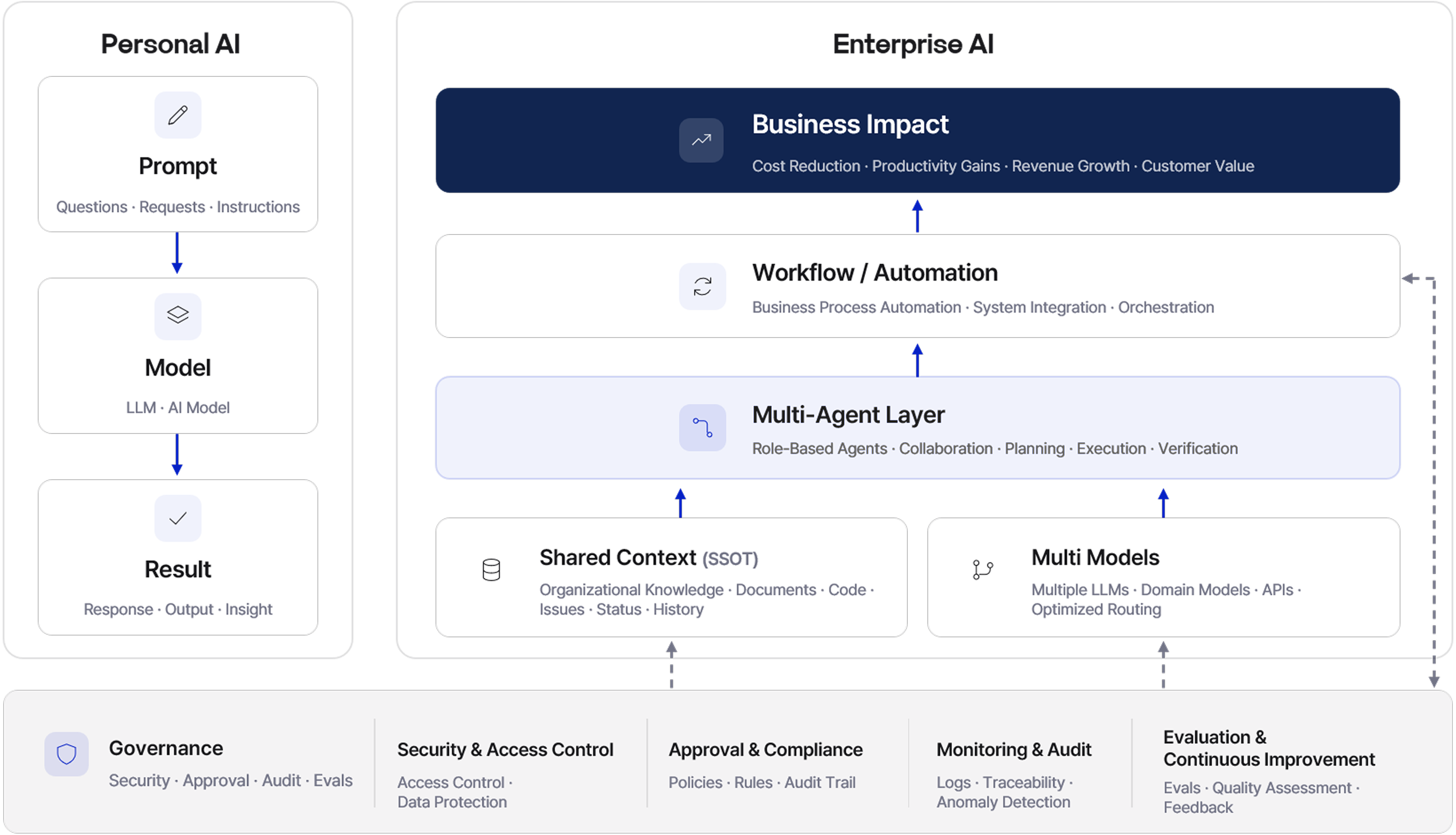
Governance, in this context, is broader than a policy document. It defines which data AI can access, which tools it can call, which actions it can run automatically, when a person needs to review the result, and how execution cost and records are managed.
An execution-oriented AI agent can generate answers, reference business systems and data, call the tools it needs, and leave behind results and supporting evidence. The role of an AI Engineer is to turn these requirements into an executable structure. Model choice still matters. Enterprise AI also needs an environment where the model can work safely and repeatedly.
Separating Work AI Can Handle from Decisions People Should Make
Teams need a clear line between work that AI can handle well and decisions that require human judgment. Without that line, AI usage may grow quickly while confidence in the results remains weak.
Tasks that are suitable for AI delegation usually have clear evaluation criteria, defined input and output formats, and results that can be compared or verified. Even when a task occurs repeatedly, model choice, execution frequency, and human approval criteria need to be designed together if cost or error risk is high. Human judgment is still required when the work involves setting goals, interpreting the criteria themselves, or making decisions with accountability.
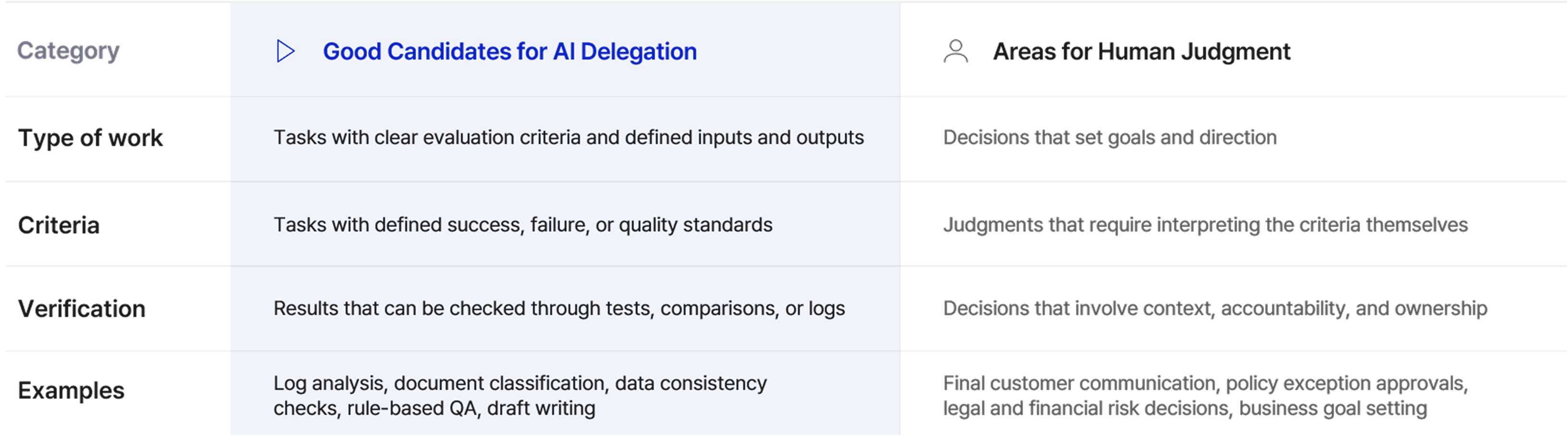
As teams delegate more work to AI, people need a clearer view of what should be delegated and where execution should stop. Even when an AI-generated result looks plausible, the responsibility for understanding the problem and checking whether the result fits the business standard remains with people.
Data and Documents Need to Be Ready for AI Access
For AI to perform work, it first needs to find and interpret the information required for that work. That includes structured data such as customer records, contracts, inventory data, production schedules, and settlement records. It also includes unstructured documents such as policies, manuals, meeting notes, emails, and operating notes.
In enterprise environments, existing documents and data need to be organized so that AI can search and retrieve them. Business knowledge does not live only in databases. It is often scattered across old documents, operator notes, team-specific rules, and exception handling practices.
To use this information properly, AI needs documents and data to be connected within the business context. If the same customer is named differently across teams, the same product is managed under different codes across systems, or the same policy is explained differently across documents, AI output can become unstable.
Adding more information is useful only when the information is organized around standards that AI can use. Teams need to define which information is authoritative, which documents are current, and how specific data connects to specific business judgments.
Execution Scope and Permissions Need to Be Defined
AI agents need tools to perform real work. They may need to read files, query systems, call APIs, and in some cases propose or execute business actions.
Enterprise environments cannot leave every tool open without limits. Teams need to define what data AI can access, what actions it can perform, and under which conditions execution should stop.
For example, AI may be allowed to query inventory data while purchase order execution requires human approval. It may draft a customer response while the actual message needs review by the account owner. It may analyze internal logs while personal data remains under a separate permission structure.
Execution-oriented AI requires permission design. Teams need to define accessible data, callable tools, automatic execution scope, and human approval conditions before AI can be connected to business workflows in a reliable way.
Results Need to Be Verifiable and Reversible
AI-generated results need to be inspectable. Teams should be able to see which data the AI used, which tools it called, and why it suggested a specific action.
Enterprise teams need more than a result that appears correct. Evidence should remain, problems should be traceable, and repeated errors should become signals for improvement.
Verification has several layers. Some parts can be checked through automated tests or evaluation criteria. Other parts require human judgment. What matters is that the execution process is observable. Execution records, logs, evidence, and before-and-after changes need to remain visible so the organization can build trust over time.
Without this structure, AI may work well in a demo and still feel unstable in real operations. With verification and recovery in place, organizations can assign more work to AI within a range they can manage.
Cost and Governance Need to Be Designed Together
AI cost can look like something to calculate later. In real operations, it becomes important as soon as usage starts to scale.
Using the strongest model for every task may feel convenient at first. Yet high-volume work such as simple classification, summarization, search assistance, or recurring reports can become expensive if every request uses a high-performance model. Work where errors are costly, such as legal review, complex policy decisions, or sensitive customer communication, may require stronger reasoning and more verification.
Enterprise AI therefore needs routing criteria by task. Teams need to distinguish work that requires fast response, work that requires cost efficiency, work that requires higher reasoning performance, and work that must be handled within an internal environment.
Governance should be designed at the same time. Teams need to define what data AI can access, which tools it can call, which actions require human approval, and where execution records are stored. These standards allow the organization to manage cost and risk as AI usage grows.
Governance gives teams the operating standards needed to delegate more work safely. The clearer the standards, the wider the range of work that can be assigned to AI.
Business Context Needs to Become a Repeatable Asset
AI Engineers make business context durable inside the system so AI can understand and execute customer workflows repeatedly.
This requires clear definitions of which data is authoritative, which documents should be referenced, which decisions belong to people, and which exceptions occur repeatedly. With that structure, AI does not need to guess from the beginning every time. It can work from standards the organization has agreed on.
Enhans uses ontology and AgentOS in this process. Ontology structures customer data, documents, business terms, and rules in a form that AI can reference. AgentOS connects that structure to AI agent execution, tool calls, result records, and human verification.
AI Adoption Needs Business Performance Criteria
Even when execution rights and governance are designed carefully, AI operations can lose direction without criteria for measuring performance. In many enterprise AI projects, goal setting is one of the hardest parts. Teams need to measure more than how naturally AI responds. They need to measure what changed in the work itself.
KPI examples include reduced processing time, fewer review cases, fewer errors and rework cycles, faster customer response, shorter decision lead time, and lower operating cost. This is also why model routing matters. The goal is to assign the right model to the right task and perform the same work faster and more cost effectively. Higher AI usage alone does not prove business performance. Teams need to confirm whether more execution leads to real business impact.
AI Engineers need to define the business outcome during implementation. Clear goals and metrics help execution rights, cost, verification, and governance operate under one shared standard.
AI Engineers Connect AI Adoption to Business Outcomes
AI Engineers define the conditions that allow an organization to delegate work to AI and check whether that execution produces business outcomes.
As model performance improves, companies can assign more work to AI. At the same time, they need clearer standards for which execution counts as meaningful performance, which decisions remain human responsibilities, and how cost and risk should be managed.
Enhans AI Engineers understand the customer's business context and design structures that allow AI to operate safely inside real workflows while connecting execution to measurable outcomes.

in solving your problems with Enhans!
We'll contact you shortly!